
Castlevania: Symphony of the Night
Konami, 1997

Symphony of the Night plays a sweet song of woe
I fully admit that I’m a little late for the Halloween party that is Castlevania: Symphony of the Night. I really stopped paying attention to the series after Super Castlevania IV, mostly because it’s a hard series and I have a lot of love for that game and the original. I didn’t need anymore Castlevania. But after coaxing from friends, making the MetroidVania connections and knowing its legendary status, here we are, and it’s taken a bite out of me.
Symphony of the Night, in all its gothic horror, appeals to me on several levels. The story is familiar in that Alucard — son of Dracula and a supporting character in the third game — is attempting to stop his father once again. That familiarity is enough to get me going because it’s all I need to know about what’s going on. Sure, I’m kind of used to a Belmont leading the way, but Symphony of the Night doesn’t need to rely on that kind of tradition.
The tradition that it does lean on is gameplay. The combat and movement are excellent, and it feels second nature to move around. Keeping it simple but adding the RPG elements was a fantastic design choice. Most of the new weapons are cool, and fighting enemies is a beautifully built song and dance. Best of all, there is an in-game map included. For a sprawling game requiring massive platforming, a map is required, and Symphony hits the mark by automatically including this.
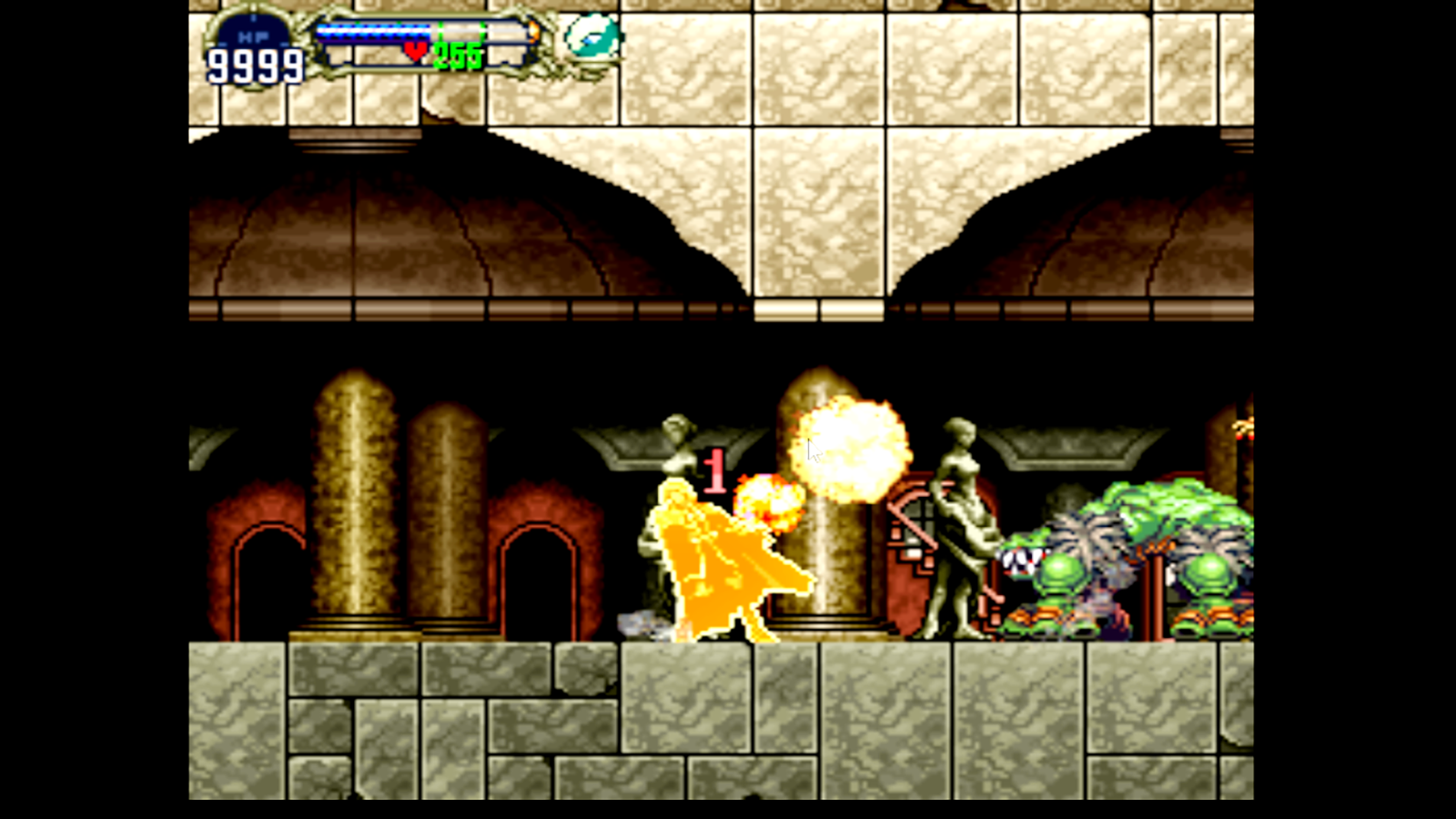
 Graphically, the game is gorgeous. Konami did something beautiful here and Castlevania looks better than ever. The gothic details are something to behold and are eye-catching as well as pleasing to someone with a goth sensibility and yearning for video games. The soundtrack is just as beautiful, necessitating finding the soundtrack to add to the collection. There are familiar riffs (Vampire Killer makes a cameo) and new chords to strike that are masterpieces, which is expected of the legendary Konami sound.
Alas, while trying to think of anything wrong with it, I’ve concluded that Symphony of the Night is a well-executed masterpiece. It hits all the marks and pulls no punches in elegance, craftsmanship. It’s telling that most Castlevania games later in the series use Symphony as the template on which they build. Symphony is a building crescendo of greatness, culminating in solid storytelling, gameplay and world-building.


 last game of the golden age,
 from Party Collection, is kind of aggravating but it’s not so terrible that the mix isn’t worth your time. It’s time consuming but it only means playing more

 to move around the playfield. My only gripe is that it’s a little hard to remember which button controls special moves. Otherwise, it’s a standard action platformer for the

 polished a little more. Some of the translation is rough and there are frequent grammar errors in the text. For a game that relies on text to get the point across, that’s too jarring and takes me out of the experience. Another gripe is that, while most of the mechanics are improved, some of the new mechanics — such as the pole vault — need some work. It’s not hard to do — once you figure it out. The problem is that it takes much too long to figure out. If I have to watch a playthrough video to get the concept, it’s doing too much.




 and his equally foolish partner Catwoman as they join forces to take over Gotham and wreak havoc. Because you are technically superior (and richer) than your foes, you have an arsenal at your disposal that helps you take out the criminal element that is doing the bidding of the meddlesome bird man and troublesome minx. Really, if you’ve watched the superb film, you shouldn’t be at a loss here as to what you need to do. It follows the plot exactly, including the encounters that Batman has with lesser henchmen. Being a game based on a movie property sometimes has its perks.
 Batman is easy to guide around, though there are a few spots where the directions and what to do could be a little more clearly pointed out. However, Batman is fluid and moves quickly enough that getting around Gotham to take on the Penguin and Catwoman isn’t much of a problem.
 myself, I know of the many battles between the
  moving left and right with the control pad, jumping with a button, and attacking with basic weapons by using combinations for special weapons. These controls have special designations for Grant, controlling how high he can jump and climb walls, and for Alucard, who can transform into a bat. To give this team of vampire hunters an extra advantage, Trevor can upgrade his mystic whip to a long-ranged chain whip and can use various Warakiya items such as the banshee boomerang, battle ax and a pocket watch that temporarily freezes enemies. Sypha has her magic staff as her main weapon in addition to using elemental orbs that can produce fire, ice and thunder attacks. Grant has use of the dagger, but he can only use the mystic ax as his secondary weapon. Alucard has use of a destructive ball that can be upgraded to shoot three directions.
 While I appreciate these effective techniques to dispatch the undead, there were flaws such as learning to time each attack or risk falling off a stage. Also, whichever partner spirit Trevor teams up with, the partner takes damage, creating a struggle to survive in certain stages. I also learned that you collect stone hearts to power weapons and if Alucard is your partner, he would turn into a bat. That’s fine but that skill eats up your hearts and if you run out, he could turn back into human form putting him and Trevor in a
 finally blew up in the U.S., and we finally started receiving mixes much like Japan. The problem was, we were getting them years after the fact, and when we did get them, they were mostly lacking — broken, incomplete messes that you were better off pretending didn’t exist. That, my friends, is where we join our story already in progress with Dance Dance Revolution Extreme 2.
 2004, a full two years after the original was released in arcades and for PlayStation 2 in Japan. That game is absolute garbage: It’s nothing like what Japan received, which is a game that’s much closer to the arcade version of Extreme. We received a broken and changed-for-the-worse song interface, missing and weird songlist and grading mechanics that were excised as of
 many years to get the hang of certain events. This is mostly because there wasn’t a lot of info out there in the days before the Internet and because, again, I had terrible untrained coordination and reflexes. Even today, with a wealth of tips out there, it’s still hard to get a bull’s‑eye in the archery, and it’s been nearly 30 years. Graphically, there’s a few things to look at, especially for an
 tend to ignore the meter altogether. Also, the foot rating is missing and song difficulty rating numbers have yet to come (that’s not until Max 2). But the song wheel has been freshened up so it looks a lot better and is a little more palatable.
 away songs like Share My Love and Dive, but overall it’s quite a few excellent choices thrown together to make a good song list. The variety is nice and it feels like a good fresh start for a series that had a lot of repeats in the first five games.