
Frankenstein: The Monster Returns
Tose, 1990

The Creature bound to better fate with NES tome
Ah, Frankenstein. This legendary horror monster has come a long way from the time his story was written by Mary Shelley. One of the most popular horror monsters of all time, Frankenstein moved from modern written adaptations to various movies, a cartoon version for a breakfast cereal and finally in video games such as Castlevania. During his video game tenure, Frankenstein has been the subject of a Bandai game in which he is the main villain, making a digital name for himself. Frankenstein: The Monster Returns for the NES was his big break.
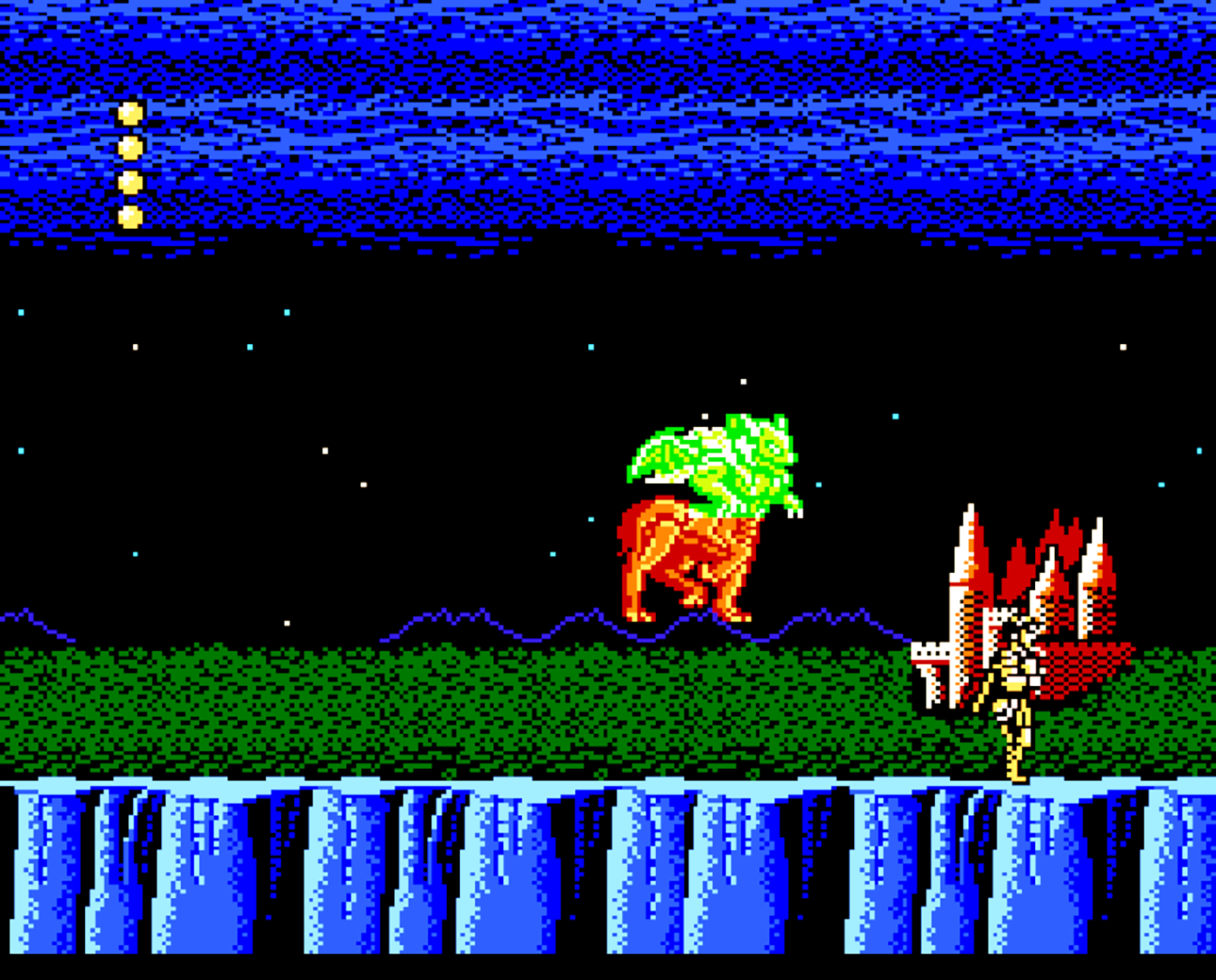
In Frankenstein: The Monster Returns, in an unknown part of Europe the legendary monster has been resurrected thanks to lighting that struck his battered tombstone in an ancient cemetery. Fully restored, Franky and his band of minions attacked a nearby village, and he kidnaps Emily, the daughter of the village elder. With Emily and all the land in great peril, it is up to an unknown hero to answer the call to finally end Franky’s reign of terror and make the land prosperous again.
 The graphics of the game are typical of common 8‑bit action-adventure games. Although I’ll give Bandai credit for attempting to match various scenes to the original novel, certain sections made me think I was playing a jumbled mix of Batman, the original TMNT, and Castlevania. Controls are also like Castlevania, which is welcome familiarity. However, this scheme can be problematic because precision is not abundant here. You will miss platforms and it’s the fault of the control design, not you.
The music is appropriately chilling and horror themed. However, sometimes it tries to do too much. Unfortunately, this is a weak spot because the music will try its best to outdo Castlevania, and it’s nowhere near that level of audio masterpiece.
Frankenstein: The Monster Returns is a campy B‑movie game that gave an iconic monster a chance to shine. Frankenstein would be second place to Castlevania since no other Universal monsters got their own game and managed to outshine Castlevania and Frankenstein. Franky’s misadventure, while not quite as good as Castlevania, is still able to scare up a good time.

 Dale to battle through several levels to do battle against Fat Cat’s legions of henchmen who are determined to stop our heroes from saving the day. Chip and Dale can jump, duck and used pint-sized boxes to throw either horizontally or vertically to defeat enemies. These boxes have various power-ups, such as acorns, to replenish health, extra lives or Rescue Rangers plaques that can earn Ranger icons. These icons will give the character of your choice an extra heart.
 unknown terrorist groups using the top-secret helicopter known as Airwolf. As String conducts the mission, he finds out that one of the prisoners being held is his long-lost brother who was declared missing in action during the Vietnam War. This gives him added incentive to carry out his given mission.
 The graphics were
 moving left and right with the control pad, jumping with a button, and attacking with basic weapons by using combinations for special weapons. These controls have special designations for Grant, controlling how high he can jump and climb walls, and for Alucard, who can transform into a bat. To give this team of vampire hunters an extra advantage, Trevor can upgrade his mystic whip to a long-ranged chain whip and can use various Warakiya items such as the banshee boomerang, battle ax and a pocket watch that temporarily freezes enemies. Sypha has her magic staff as her main weapon in addition to using elemental orbs that can produce fire, ice and thunder attacks. Grant has use of the dagger, but he can only use the mystic ax as his secondary weapon. Alucard has use of a destructive ball that can be upgraded to shoot three directions.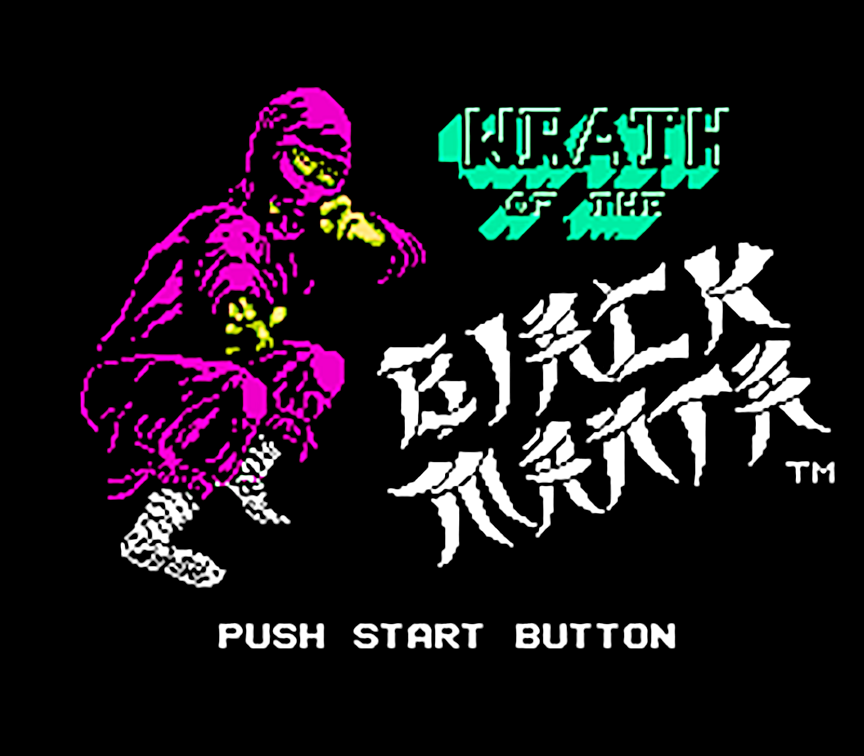
 because it seems to be a million and one games about ninjas that were made in the 1980s. These were all made with various degrees of success in getting the point across about the ninja experience. Out of the coterie there were two that stood out: Ninja Gaiden, a timeless classic in the way of the ninja arts; and, Wrath of the Black Manta. Note that we did not use any sort of kind tribute for the latter. There is myriad reasons for this distinction.
 children in New York City, the apparent bastion of all evil and where the most heinous crimes take place in the video game world. A drug fiend named El Toro is hellbent on turning these children into addicts and it’s up to you and your ninja skills to make Toro get down or lay down with the War on Drugs.™
 ruled my weekends and I was fortunate to find some rare gems that later became gaming classics. During that time, I played 1942 in the arcade and on the
  chance against these planes, it can do air rolls or vertical loops. If you time your attacks right, some planes will drop upgraded firepower or an escort team of two smaller fighter planes to combat the relentless assault from planes that
  The music quality of 1942 is an acquired taste as the repeated use of a snare drum made me think that Capcom phoned in a lackluster drum beat, which made me turn the volume down to continue playing. The challenge is decent since you will be on your toes to avoid enemy fire nonstop. It has strong replay value and would be a great time-killer as a nostalgia trip for arcade veterans. Also, it’s a great example for those who want to know how side-scrolling games played a major impact in the gaming world.
 a nightmare and a chore to actually control. The Fighter flaps his arms to stay afloat and even with both balloons still present, this is extra hard to do and maintain. More often than not, I don’t lose balloons because an enemy popped them; it’s because I landed in the water, was eaten by the large fish or steered myself unwittingly into the lightning I was desperately trying to avoid. Precision flying this is not. To get a sense of what it’s like to control the Fighter, imagine if the horrible Ice Climbers were flying instead of jumping terribly up a mountain.
  And while the game is barely playable, the soundtrack also manages to squeak by in presentation. It is a sad day when I declare that a soundtrack from Metroid sound director Hip Tanaka is irredeemable. There is nothing that makes me want to listen to this, and nearly everything that Tanaka has created gets high marks from me. The songs aren’t memorable, there are few songs there anyway, and the lack of varied sound effects is disconcerting. Add the soundtrack woes to an underwhelming graphical palette and the game overall is a mess.
 friendly. If you didn’t start with Super Mario Bros., stop right now and go back and study up that game. The sequel is designed to be set up and buoyed by the original. If you start here, you’re setting yourself up for failure.
 This frustrating tactic of punishing the player for being too good is exactly why the follow up to Super Mario Bros. would have never flown in America and why we didn’t see the game until a full five years after its release in Japan. People traditionally play Mario to relax, not be thrown backward in a never-ending loop of anger and frustration. This doesn’t appeal to the mass players and it’s cheap and perverse that Mario is used in this way.
 it meant to duel an older sibling who had far better hand-and-eye coordination and reflexes and why teenagers seem to do much better at games than little kids.
 many years to get the hang of certain events. This is mostly because there wasn’t a lot of info out there in the days before the Internet and because, again, I had terrible untrained coordination and reflexes. Even today, with a wealth of tips out there, it’s still hard to get a bull’s‑eye in the archery, and it’s been nearly 30 years. Graphically, there’s a few things to look at, especially for an
 hell and high water. But wait, this time it’s different! No, you aren’t saving Pauline this time around; no, you’re Donkey Kong Jr., the scion of Kongdom saving your incorrigible father from the clutches of evil human Mario. The fact that another ape has to save his parental figure from Mario in a complete role reversal begs several questions: Where was Junior when his father was kidnapping innocent maidens and running rampant? Why would Mario even bother to kidnap the great ape in the first place? Sure, there’s the motive of revenge, but you’re never going to get your question answered, try as you might. You just have to accept that