

Furry duo return in solid fun
In a previous issue, I reviewed Disney’s Chip ’n Dale Rescue Rangers for the NES. I reviewed the game as a nod to the times of the late ’80s and early ’90s where you knew the ins and outs of your favorite shows, including the opening and ending theme songs. With the arrival of Disney+ and Capcom’s re-release of Disney Afternoon-themed games for current consoles, I heard that Disney’s dynamic duo had another game for the NES. I reviewed Chip ’n Dale Rescue Rangers 2 to see if it would jump start my carefree kid memories.
 Rescue Rangers 2 starts off with our furry heroes and their comrades enjoying a well-deserved rest after stopping their notorious arch nemesis, Fat Cat, in the first game. However, like most great villains, Fat Cat was able to mastermind his escape from prison and acquire the legendary Urn of the Pharaoh to re-launch his fiendish plans. With Fat Cat on the loose and having evil spirits at his disposal, the Rescue Rangers are the only ones standing between Fat Cat and world peace.
Rescue Rangers 2’s gameplay is exactly like the original; you can choose either Chip or  Dale to battle through several levels to do battle against Fat Cat’s legions of henchmen who are determined to stop our heroes from saving the day. Chip and Dale can jump, duck and used pint-sized boxes to throw either horizontally or vertically to defeat enemies. These boxes have various power-ups, such as acorns, to replenish health, extra lives or Rescue Rangers plaques that can earn Ranger icons. These icons will give the character of your choice an extra heart.
The controls also remain the same from the first game. Rescue Rangers veterans will be familiar with the control layout, but newcomers will go through trial
and error until they are comfortable.
All the levels and backgrounds were done with great care, making me believe that I was playing an actual episode of Rescue Rangers. I commend Capcom for letting Disney animators work their magic on heroes and boss characters, ensuring that the bosses provided a challenge without losing Disney elements.
 As much as I enjoyed Rescue Rangers 2, it’s not without some flaws. I stated earlier that controlling either Chip or Dale would take practice; that is important since during stages, you cannot go back to a lower level to pick up items without losing a life. That makes things unnecessarily tough. Also, the Rescue Rangers’ roles were drastically from the first game. The first game incorporated Monterey Jack, Gadget and Zipper into finding hidden paths, scouting for enemies, and backup and reach support; they’re now reduced to background scenery with little screen time.
Audio-wise, the music sounds dialed-in like the music from “1945,” showing that Capcom’s development starts strong but becomes weak in certain areas. Finally, the challenge level is high, but I advise players to have special cheat codes enabled if they want to finish this game. You shouldn’t have to use them, but they are a must here.
Chip ’n Dale Rescue Rangers 2 has delivered, keeping intact all the elements that made it a Disney favorite but, unfortunately, keeps some of Capcom’s bad habits as well. The Disney Afternoon lives on in this small but solid sequel.
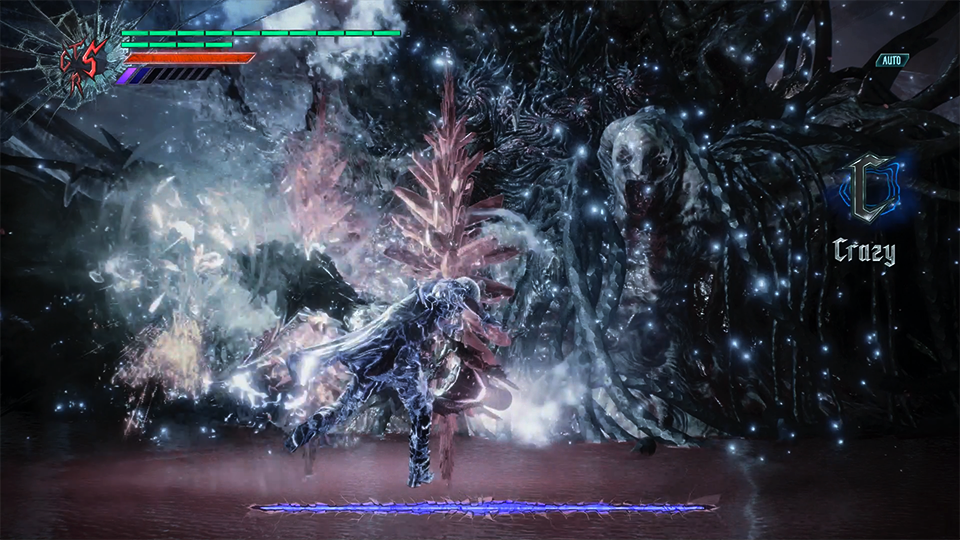 the demon-hunting business but one May night, Nero is accosted by a familiar foe who has not only taken the demon sword Yamato, but also Nero’s demonic arm. Vowing vengeance, Nero pursues the foe to Redwood City where he is introduced to a new evil known as Urizen. He, Dante and fellow demon hunters Trish and Lady are swatted instantly by Urizen. Now having a
  Gameplay in
 unknown terrorist groups using the top-secret helicopter known as Airwolf. As String conducts the mission, he finds out that one of the prisoners being held is his long-lost brother who was declared missing in action during the Vietnam War. This gives him added incentive to carry out his given mission.
 The graphics were
 moving left and right with the control pad, jumping with a button, and attacking with basic weapons by using combinations for special weapons. These controls have special designations for Grant, controlling how high he can jump and climb walls, and for Alucard, who can transform into a bat. To give this team of vampire hunters an extra advantage, Trevor can upgrade his mystic whip to a long-ranged chain whip and can use various Warakiya items such as the banshee boomerang, battle ax and a pocket watch that temporarily freezes enemies. Sypha has her magic staff as her main weapon in addition to using elemental orbs that can produce fire, ice and thunder attacks. Grant has use of the dagger, but he can only use the mystic ax as his secondary weapon. Alucard has use of a destructive ball that can be upgraded to shoot three directions.
 space mecha anime has brought thought-provoking perspectives on issues of humanity and war, and has created a standard for all sci-fi series, especially anime with sci-fi and mecha elements. Through various series, merchandise (including video games for various consoles) and other media, Gundam and its studio, Sunrise Inc., has secured its place among the GOATs of global pop culture. Lyndsey and I have also taken a liking to the Dynasty Warriors game series. I thought: “What would happened if a Dynasty Warriors game was made with Gundam elements?” I got my answer in Dynasty Warriors Gundam 3.
 and determination. Your requests come from a mysterious Gundam suit that asks why humanity’s existence in the universe should continue. This test is conducted in four original story arcs that pair characters from various Gundam series such as the
  At the end of each stage, your character will be shown how many experience points he or she earned and how much gold was collected. These elements help you to earn new skills and more stronger suits. To help your character out, there is a tutorial stage with practice missions that will help them earn more points or to refresh basic skills.
 than 50 characters from 32 series within the Shonen Jump universe and pits them against each other in various locations within each
 by Dr. Light years after the original Mega Man. X is a more powerful version of our blue titan but with free will. 100 years later, after Dr. Light’s death, X was found by Dr. Cain, a robotics expert who developed robots based on X’s design known as “reploids.” However, this began a rise of rebellious reploids, known as mavericks, which led to the formation of a group known as maverick hunters to stop them. Alas, the maverick hunter’s leader Sigma became a maverick (and the series’ main villain), forcing X to team up with another maverick hunter named Zero to stop Sigma’s plan for global domination.
 Control of X is simple as any regular side-scrolling game, especially with the option of switching between the analog sticks or directional buttons. X’s main weapon, the X‑Buster, and other weapons he acquires from a level boss can be powered up in addition to finding upgraded boots, helmet and armor via secret areas in each level. Using a sub screen, I appreciated that it was understandable and simple in organizing items and weapons since, in other side scrolling games, looking for needed items is time consuming and morale-draining. Zero is also playable in
 chance against these planes, it can do air rolls or vertical loops. If you time your attacks right, some planes will drop upgraded firepower or an escort team of two smaller fighter planes to combat the relentless assault from planes that
  The music quality of 1942 is an acquired taste as the repeated use of a snare drum made me think that Capcom phoned in a lackluster drum beat, which made me turn the volume down to continue playing. The challenge is decent since you will be on your toes to avoid enemy fire nonstop. It has strong replay value and would be a great time-killer as a nostalgia trip for arcade veterans. Also, it’s a great example for those who want to know how side-scrolling games played a major impact in the gaming world.
 Free Battle mode allows you to choose one main fighter with two backup characters against another player or the console’s choice of characters in various stages taken right out of the Naruto universe. Free Battle also allows you to earn extra cash if you defeat their opponents using various moves known as ninjutsu. The extra coinage will be needed in the role playing mode, Ultimate Mission Mode, during which you control Naruto in various missions that involve episodes 1 to 135 of the anime series.
 has changed for a more intense experience. Taking place in a remote island town called Fortuna, you assume the role of Nero — a younger version of Dante — who is a member of the Order of the Sword. The Order of the Sword is a militant religious organization formed to destroy demons based on the actions of the Demon-Knight Sparda, who rebelled against the demon underworld to protect humanity. At a recent ceremony to honor Sparda, Dante smashes though a skylight and kills the priest leading the ceremony, setting off a chain of events that would not only put Dante and Nero on a collision course with each other, but also would lead both demon-hunters through a greater mystery to find out the true intentions of the Order and to stop a more vicious plot of a demon-invasion.
 The excellent detail that is used in each level comes to life in the background and cinematic scenes. These were done with high definition technology that will make you feel like you are playing with a masterpiece of art instead of a video game. Capcom’s sound team brings their A‑game again. Each sound and vocal effect combined with Dolby Digital Sound gives an orchestral quality to the game. Capcom did a great job in voice and motion capture for