

Photos courtesy of GiantBomb.com
Maximo continues the quest to rescue the princess
I have a love and hate relationship with Capcom. For every game they develop and  publish that will be a smash hit by being more creative and sticking to the basics, they churn out five or six copies of the same game without breaking any new ground (i.e. Street Fighter V). I won’t even mention how they studied the Konami code of disposing of one of their greatest game series and its leader. With this view of Capcom off my chest, let’s look at a game that is original and has become a successor to the classic games Ghosts ‘N Goblins and Adventure Island: Maximo: Ghosts to Glory.
You take the role of said character, Maximo, who, after returning from a battle to  protect his kingdom, finds out that his main lady Queen Sophia is captured by his once-trusted adviser, Achille. To make matters worse, Achille has developed a drill that has pierced the underworld, allowing him to create an army of undead monsters to terrorize the kingdom. All is not lost as is seems that as Maximo was free-falling, the Grim Reaper makes a deal for him to return to the living world in exchange for returning the lost souls to the underworld. Maximo accepts and begins his quest to free Sophia and restore the peace taken by Achille.
 Maximo retains the elements from Ghosts ‘N Goblins and Adventure Island but allows freedom to explore all of the stages thanks to its 3D design. Maximo has the ability to run, jump and crouch to avoid enemies and is easily controlled with use of the analog control stick. Maximo is also ready for battle with his trusty sword and shield, which can be thrown at approaching enemies and capable of wiping out all enemies on the screen if the right power-ups are applied. In addition to his sword and shield, Maximo has his armor which, if all the parts are gathered, he becomes invincible for a brief period.
A heads up: Make sure that Maximo keeps his armor as long as possible since like Arthur in Ghosts ‘N Goblins, if Maximo takes too many hits, he would be down to his boxers, which would lead to his death if he takes another hit. Also, controlling Maximo is not difficult, but some practice is recommended to get adjusted to moving around.
The stages are excellently designed and guaranteed to make you feel that you’re in Maximo’s world. The game’s music is an enjoyable mix of original and remastered tracks from the original Ghosts ‘N Goblins. The challenge level is ridiculously high, guaranteeing great replay value.
Maximo: Ghosts to Glory is one of those type of games that will please fans of old-school adventure gaming who want to play the genre with the latest technology. In my opinion, Maximo is also a example of what Capcom can do when they allow creativity to flourish instead of always milking their golden franchises to death.
Well done, Capcom. Well done.

 tutorials for players to master Dante’s moves and his signature weapons. In addition to the tutorials, four different combative arts called “styles” are available to Dante, giving him various abilities to increase the power of various guns, striking weapons, dodge attacks, and unleashing hand-to-hand combat with devastating results. Once Dante defeats a certain boss, he will be able to use them in the form of unique, various weapons. There is a lock-on feature to directly target enemies that, with practice, will be a valuable tool to rip enemies apart. Also in the special edition, there are two modes of play: Normal, which is basic
 perform “Issen” (lighting slash) on various enemies, allowing him to continue forward, giving him a brief minute to defend himself or retreat. Another element is the requirement to solve certain puzzles to obtain certain items or gain access to certain areas. For these puzzles, I highly advise utilizing patience and strong memorization as they have a much stronger effect in Onimusha 2 than in the first game. The final new element is role playing that enhances the storyline. Jubei can not only interact with non-playable characters, but also gain allies who will give information or assist him in boss battles provided he is in constant contact with them or if his allies are not involved in their own plans to defeat Nobunaga.
 In addition to new allies, you will notice that Jubei is normally equipped with his sword, but can acquire weapons such as bows and arrows, a matchlock gun and other weapons that use the power of natural elements. Jubei does have two other advantages to help as well: The ability to temporarily transform into Onimusha with enhanced attack power; and, the power to acquire various souls without the use of a ogre gauntlet to upgrade his armor and weapons.
 It’s simplified even more thanks to the Wii’s Classic controller, GameCube controller, third-party arcade sticks and the regular Wii remote. You will love the character roster consisting of each companies’ top franchises such as Street Fighter, Rival Schools, Viewtiful Joe, Lost Planet, Darkstalkers/Vampire and Mega Man for Capcom while Tatsunoko is represented by Karas, Tekkaman, G‑Force and Yatterman. There are other characters that can be unlocked via use of money (Zenny) earned in each game, which also will allow purchase of alternate endings, costume changes and other unlockable surprises.
  already a fan of most Capcom fighting properties, and I love the Versus series, so I’m going to play whatever they come up with next to join forces with and create magic. In this case, it’s anime related as well, so there’s a winning combination all the way around.
 return to time and time again. Nice mechanics, an interesting roster and gorgeous attention to detail with the environments and soundtrack make it a nice package. My only gripes are that the story doesn’t really make a whole lot of sense (really, Yami from Okami, Capcom? That’s it?), and that not knowing that much about Tatsunoko actually works against me. Other than that, there’s isn’t a reason why I wouldn’t play this constantly, even if it is a Wii exclusive. That’s just another reason to go out and buy the now-defunct console.
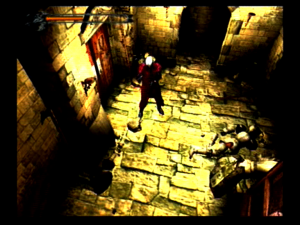 unethical scientific experiments. You assume the role of Dante, a demon hunter/investigator who uses his skills to exercise demons for profit and to avenge the loss of his family from said creatures. One night while working, Dante is hired by a mysterious woman named Trish, who after a brief but amazing test of Dante’s skill, hires him to go to an abandoned castle where Mundus, the demon who is responsible for the death of Dante’s family, is planning a return from hell. Unknown to our badass hero, he has taken on a a job that starts out as an opportunity for vengeance, but soon will unlock an ancient birthright and his true destiny as mankind’s newest protector against demonic forces.
 The graphics are beautiful as Capcom developed a great game engine and made great use of the PS2’s technological capabilities to bring out the action without using the god-awful camera angles found in Resident Evil. I personally liked how each cutscene brought DMC’s storyline together without any over-the-top drama. The enemy variety is good, too, ranging from demon marionettes to giant owls and other demonic creatures. I enjoyed the voice acting because it was not forced, flowing in sync with the game’s plot. I am proud to say that I would definitely replay this game when I’m feeling like I want to rip some demons apart.