

Ambitious guide to greatness
I’m apparently no battlefield general. I learned this fascinating tidbit about myself  within a rather rough short season of my gaming life through disastrous decisions and lack of preparation. My troops weren’t ready, I didn’t have enough horses and my crops failed to sustain my garrison. Even my samurai and ninja were taken out quickly. I was outmanned, outmatched and decimated before I knew what hit me. Suffice to say, if I had been Oda Nobunaga, feudal Japan would have been in shambles like my mentions on Twitter these days. That is the way in Nobunaga’s Ambition.
Ambition is not for the faint of heart. It requires serious planning, thoughtful tactical strikes, and good resource management. At its core, Nobunaga’s Ambition is a war simulation that takes you through feudal Japan’s revolutionary period, where  unification was the goal and Nobunaga was the man to do it — possibly. While you can choose to be Nobunaga, you can be any other number of generals from different regions of Japan at the time. You’re tasked with raising an army, gathering and maintaining supplies, and defending your region while conquering others in a bid to unify all of Japan under your shogunate.
You roam around the Japanese countryside with your troops and challenge the other generals in a turn-based battle sometimes to the death. If successful, your name will be mentioned in history as a great general and the unifier, much as history played out with Nobunaga’s victory over Shogun Ashikaga Yoshiaki in 1582 and his successors’ battles after his death.
The premise is unique, though to fully appreciate what it is you’re doing and why, you probably will have to be a history geek or interested in Asian history. It’s niche but fun with a lot of historical education thrown in.
 Its niche context aside, the game is fun to play once you fully get into the simulation. It’s a very 1993 presentation. The graphics are small for the maps, but they’re reminiscent of the graphics of the time for the SNES and Windows games. The standout among the graphics, though, are the general portraits. They’re colorful — as are the other graphic elements — but are also beautifully detailed. For a SNES game, the graphics are top notch and still can compete with the big titles of the era.
The music can be a little grating but it’s not overly terrible. There are a few different songs for the menus and battle, and while slightly tinny, they are OK in a short-term play setting.
If you’re into strategy simulations and Japanese history, let curiosity strike and settle in for a rousing battle. Nobunaga’s Ambition is enough to get you started in the genre and is destined to lead to greater things.

 Guy defeated the Mad Gear gang, restored peace to the streets of Metro City and rescued Haggar’s daughter Jessica from the Mad Gear’s leader, Belger. That peace is short-lived when the remnants of Mad Gear return under a new leader and kidnap Guy’s fiancée, Rena, and Guy’s sensei, Genryusai.


 discovered the upgrade. The home port of Super Street Fighter
  Hyper Fighting, but it’s Street Fighter at peak Street Fighter. That also applies to the controls. It’s the Street Fighter that you know and love but cleaned up just a tad.
 Batman is easy to guide around, though there are a few spots where the directions and what to do could be a little more clearly pointed out. However, Batman is fluid and moves quickly enough that getting around Gotham to take on the Penguin and Catwoman isn’t much of a problem.
 a great soundtrack and decent controls and not be so obnoxiously unplayable that legions of older gamers remember it with a certain hatred that burns deep within their soul to be passed down through generations to come. Cool Spot, licensed from Pepsi partner
 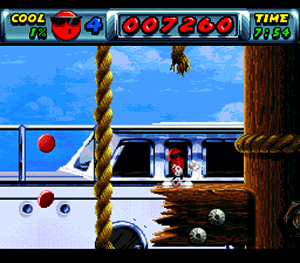 throughout 11 levels in cages. Why its friends are trapped, we’ll never know but it’s up to Spot to rescue them and lecture you about not drinking dark sodas. Spot’s traversal through these 11 levels is nothing short of amazing despite the rampant product placement. It’s surprisingly good, with solid controls that don’t make controlling Spot a chore, and competent simple mechanics that don’t get in the way: It’s mostly jumping and shooting magical sparks at enemies and barred gates. The life system — hilariously denoted by an ever-peeling and deteriorating picture of Spot — is more than generous and there are helper power ups galore to get through levels. The levels themselves have a lot of depth and are timed just right with enough time to explore or get the bare minimum experience in the search for Spot’s missing friend.
 further bubbles. After a certain number are cleared, the ceiling of the well lowers, inching closer to a visible line. Once the line is crossed with a bubble, the game is over. Basically, it’s reverse Tetris with bubbles instead of lines. The trickiness in mastering the game comes in popping the bubbles. There are different techniques to achieving the results that you want, but it really comes down to knowing how to aim and learning the fabled bankshot off the side of the well.
 With its simplicity in learning, Bust-A-Move quickly distinguishes itself as fun to play. I requested the game for my 14th birthday, and I’ve had a blast playing the original since. There are other games in the series, but this one is the best out of all of the sequels and spinoffs of the series. The controls aren’t too stiff, though sometimes I have complaints about the particular way a bubble bounces or sticks a little too easily to the first bubble it comes close to. Yet, the controls aren’t horrible.
