

Onimusha 2 has elements of satisfying sequel
Previously, I reviewed the first game in Capcom’s critically acclaimed series Onimusha,  where historic figures and moments in Japanese history were mixed with action/adventure gaming, third-person combat and brief moments of puzzle solving. After playing the first game, I wondered if the second installment would keep the successful formula and raise the bar for future installments. When I received Onimusha 2: Samurai Destiny, I put on my custom-made samurai armor and prepared to have my questions answered.
Onimusha 2 continues the plot of chosen warriors working to prevent Oda Nobunaga from unifying Japan through the use of demons called genma. Set 10 years after the first game, Nobunaga has risen to power despite the defeat of his demonic benefactor Fortinbras, who was stopped by original protagonist Samanouske Akechi. With Samanouske in hiding to perfect his new demon slaying abilities, it’s up to Jubei Yagu to take up the sword and acquire five legendary orbs and use them to stop Nobunaga before his dark plans of conquest becomes reality and demons become the dominant species of Earth instead of man.
Gameplay in Onimusha 2 remains the same but does have some new elements. During combat with enemies, you can still fight through enemies, but if timed correctly, Jubei can perform “Issen” (lighting slash) on various enemies, allowing him to continue forward, giving him a brief minute to defend himself or retreat. Another element is the requirement to solve certain puzzles to obtain certain items or gain access to certain areas. For these puzzles, I highly advise utilizing patience and strong memorization as they have a much stronger effect in Onimusha 2 than in the first game. The final new element is role playing that enhances the storyline. Jubei can not only interact with non-playable characters, but also gain allies who will give information or assist him in boss battles provided he is in constant contact with them or if his allies are not involved in their own plans to defeat Nobunaga.
 In addition to new allies, you will notice that Jubei is normally equipped with his sword, but can acquire weapons such as bows and arrows, a matchlock gun and other weapons that use the power of natural elements. Jubei does have two other advantages to help as well: The ability to temporarily transform into Onimusha with enhanced attack power; and, the power to acquire various souls without the use of a ogre gauntlet to upgrade his armor and weapons.
The controls will not present any level of difficulty especially if the Dual Shock analog controller is used. You can appreciate the quality of the characters’ movements in gameplay and in the cut-scenes which may make one wonder if they are playing a samurai adventure game or watching a movie.
The music performed in this game is excellent as Capcom’s sound team always brings their best efforts, guaranteeing that the music will be a treat. If you enjoy instrumental Japanese themes, you’ll probably love the soundtrack.
Onimusha 2: Samurai’s Destiny did exceeded my expectations for a game to be considered a true samurai masterpiece. This not only shows that Capcom can unleash their brilliance if they really try, but also shows other developers that in order to bring a superb gaming product involving various elements of Japanese culture, they must willfully present historical elements properly while crafting a high quality storyline. I can not wait to start the next chapter of the Onimusha series where the next destined hero strikes another blow to Nobunaga’s ambitions.


 While the challenges may be different, there isn’t much else different about the games. The music and graphics from the 8‑bit era remain intact and about the only thing that’s changed is the slick modern packaging of the Ultimate Remix itself and the addition of leaderboards and championship mode. So, don’t come into this expecting depth or some magical upgrade to modern day standards of graphics.
 repertoire of the Prince, such as the Prince Hop and the King Shock, but otherwise you’re still rolling along to pick up items to make your katamari grow. The series isn’t known for its growth and this is a major reason why. While it’s easy to control the Prince and maneuver the Katamari, there still should be some innovation at this point, five games in.
 much like playing any platformer of the past 20 years and the control scheme is simple and intuitive in letting you figure out what to do and how to apply it later. Where it falters is the jumping mechanics. While obvious and simple, the jumping does feel slightly off and floaty, which is a problem in a game that relies on that mechanic to carry it. It’s annoying to have to re-do sections of a level solely because of a missed jump, and that detracts from the core experience.
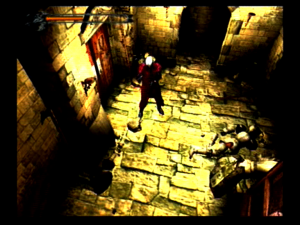 unethical scientific experiments. You assume the role of Dante, a demon hunter/investigator who uses his skills to exercise demons for profit and to avenge the loss of his family from said creatures. One night while working, Dante is hired by a mysterious woman named Trish, who after a brief but amazing test of Dante’s skill, hires him to go to an abandoned castle where Mundus, the demon who is responsible for the death of Dante’s family, is planning a return from hell. Unknown to our badass hero, he has taken on a a job that starts out as an opportunity for vengeance, but soon will unlock an ancient birthright and his true destiny as mankind’s newest protector against demonic forces.
 The graphics are beautiful as Capcom developed a great game engine and made great use of the PS2’s technological capabilities to bring out the action without using the god-awful camera angles found in Resident Evil. I personally liked how each cutscene brought DMC’s storyline together without any over-the-top drama. The enemy variety is good, too, ranging from demon marionettes to giant owls and other demonic creatures. I enjoyed the voice acting because it was not forced, flowing in sync with the game’s plot. I am proud to say that I would definitely replay this game when I’m feeling like I want to rip some demons apart.
 chose between using X and Zero, who each have unique abilities. I chose Zero because of the option to use his Z‑Saber and Z‑Buster as more effective combat tools, and also because of his stronger jumping abilities.
  armor from
 relationship with them so that you are considered neighborly. The town’s set schedule makes for interesting interactions and a type of schedule planning not unlike Animal Crossing. While you’re working to save your farm and chatting up the townsfolk, you’re given a third task of finding a suitable lass in town to wife up. If you can manage to put a ring on it by wooing your intended (there are five lovely ladies that you can choose from to pursue with varying likes and dislikes), you’re all but guaranteed to earn your place in the town and be allowed to stay.

 Eidos/Montreal and Square


 immediately sets the game apart from its competition of the time. The game flat-out looks great on the GameCube, and the other console versions looked great, too. The GameCube version has an interesting control scheme that lends itself to rolling down the slopes, and it’s intuitive and becomes second nature as you become more comfortable pulling off various tricks. For that increasing level of comfort, you are rewarded with bigger and better items that should help you improve as well as make you look a little better on the track. It’s that drive to unlock these goodies and tracks that keeps you coming back to Tricky.
 atmosphere