

Devil’s in the details: DMC4 a nice break from Dante
Capcom’s “Devil May Cry” series is a game that has basically redefined the term “hack- and-slash” in video games. With the first three games using hack-and-slash style as well as action-adventure elements, I wondered what new surprises would the fourth installment of the series bring and to which system?
DMC 4 features demon-hunter extraordinaire Dante, but the story and main character 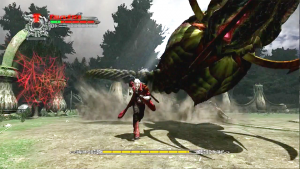 has changed for a more intense experience. Taking place in a remote island town called Fortuna, you assume the role of Nero — a younger version of Dante — who is a member of the Order of the Sword. The Order of the Sword is a militant religious organization formed to destroy demons based on the actions of the Demon-Knight Sparda, who rebelled against the demon underworld to protect humanity. At a recent ceremony to honor Sparda, Dante smashes though a skylight and kills the priest leading the ceremony, setting off a chain of events that would not only put Dante and Nero on a collision course with each other, but also would lead both demon-hunters through a greater mystery to find out the true intentions of the Order and to stop a more vicious plot of a demon-invasion.
While Dante’s role in DMC 4 is not as the main character, he does still play a key role in the game as a playable character in certain scenes. Nero is not to be taken lightly either as his arsenal consists of his Devil Bringer arm, his mechanical sword Red Queen and his double barrel revolver, Blue Queen. Nero can gain an extra advantage to accomplish his mission by gathering “Red Souls,” DMC’s original game currency, and “Proud Souls,” a new currency. After a mission is completed, Pride Souls can power up Nero’s tools ranging from extending the Devil Bringer’s reach to more powerful shots from the Blue Queen. The controls for Dante and Nero are easy to use thanks to the PS3’s Six Axis controller’s built-in analog feature, which I found helpful with camera issues from time to time.
 The excellent detail that is used in each level comes to life in the background and cinematic scenes. These were done with high definition technology that will make you feel like you are playing with a masterpiece of art instead of a video game. Capcom’s sound team brings their A‑game again. Each sound and vocal effect combined with Dolby Digital Sound gives an orchestral quality to the game. Capcom did a great job in voice and motion capture for DMC 4. Johnny Yong Bosch (Bleach, Street Fighter IV) brought Nero to life and Reuben Langdon reprising his role as Dante.
Devil May Cry 4 shows what Capcom is capable of doing when they let their development team do its job: make their games enjoyable. DMC4 is a challenging, but enjoyable way to kill free time when you want to get your demon-hunting on. The replay value is strong especially if you are a veteran DMC player; this game is worth your hard-earned cash.

 Marvel, Street Fighter, Tekken and Mortal Kombat for tournament purists, a new Soul Calibur has been announced, and a new Smash is on the horizon and the older games in the series are still played in some circles. Guilty Gear, which has always been quietly in the back of the lunchroom, was a mix of tournament and casual, so it stands to reason that its spiritual successor — BlazBlue — would mimic that notion.
 modes to choose from. If you’re not informed, you might be a little lost trying to understand just where you should start. With a varied plate to choose from, at the very least the modes are interestingly designed and add value to an already-packed game.
  Learning the mechanics for most fighting games is a mixed bag. Some games expect you to be able to jump in and master the basics as if you’ve done nothing but play fighting games all of your gaming life. Others like to give you a tutorial so that you’re not lost and quickly putting the game down, never to return. BlazBlue
 Festival takes that concept and turns it on its head. With Festival, you’re tasked with moving around a typical Animal Crossing town in the form of a large board game. The town is transformed by spaces that can be events, Stalk Market sale stops and visits from the usual assortment of guests that visit a normal town in the franchise.
 protect his kingdom, finds out that his main lady Queen Sophia is captured by his once-trusted adviser, Achille. To make matters worse, Achille has developed a drill that has pierced the underworld, allowing him to create an army of undead monsters to terrorize the kingdom. All is not lost as is seems that as Maximo was free-falling, the Grim Reaper makes a deal for him to return to the living world in exchange for returning the lost souls to the underworld. Maximo accepts and begins his quest to free Sophia and restore the peace taken by Achille.
  Maximo retains the elements from Ghosts ‘N Goblins and Adventure Island but allows freedom to explore all of the stages thanks to its
 a nightmare and a chore to actually control. The Fighter flaps his arms to stay afloat and even with both balloons still present, this is extra hard to do and maintain. More often than not, I don’t lose balloons because an enemy popped them; it’s because I landed in the water, was eaten by the large fish or steered myself unwittingly into the lightning I was desperately trying to avoid. Precision flying this is not. To get a sense of what it’s like to control the Fighter, imagine if the horrible Ice Climbers were flying instead of jumping terribly up a mountain.
  And while the game is barely playable, the soundtrack also manages to squeak by in presentation. It is a sad day when I declare that a soundtrack from Metroid sound director Hip Tanaka is irredeemable. There is nothing that makes me want to listen to this, and nearly everything that Tanaka has created gets high marks from me. The songs aren’t memorable, there are few songs there anyway, and the lack of varied sound effects is disconcerting. Add the soundtrack woes to an underwhelming graphical palette and the game overall is a mess.
 further bubbles. After a certain number are cleared, the ceiling of the well lowers, inching closer to a visible line. Once the line is crossed with a bubble, the game is over. Basically, it’s reverse Tetris with bubbles instead of lines. The trickiness in mastering the game comes in popping the bubbles. There are different techniques to achieving the results that you want, but it really comes down to knowing how to aim and learning the fabled bankshot off the side of the well.
 With its simplicity in learning, Bust-A-Move quickly distinguishes itself as fun to play. I requested the game for my 14th birthday, and I’ve had a blast playing the original since. There are other games in the series, but this one is the best out of all of the sequels and spinoffs of the series. The controls aren’t too stiff, though sometimes I have complaints about the particular way a bubble bounces or sticks a little too easily to the first bubble it comes close to. Yet, the controls aren’t horrible.
 play begins: For every line cleared, a small amount of energy is added to a magic meter. Fill up the magic meter and you get what we’ve termed at
  The game shines in its visuals, which benefit from that Disney touch. The game is bright and colorful and designed in the way of Disney games and animation, meaning it’s top-notch through and through. The graphics are still good for an N64-era game and haven’t aged badly. The soundtrack has aged well, too, and is still one of the best of the era. Each character’s stage is memorably themed and stands out enough for you to remember it well after your game is over.
 tutorials for players to master Dante’s moves and his signature weapons. In addition to the tutorials, four different combative arts called “styles” are available to Dante, giving him various abilities to increase the power of various guns, striking weapons, dodge attacks, and unleashing hand-to-hand combat with devastating results. Once Dante defeats a certain boss, he will be able to use them in the form of unique, various weapons. There is a lock-on feature to directly target enemies that, with practice, will be a valuable tool to rip enemies apart. Also in the special edition, there are two modes of play: Normal, which is basic

 checking out by itself. On the other hand, the difficulty and rating system make it a frustrating experience. If you’re used to the rubber band
 friendly. If you didn’t start with Super Mario Bros., stop right now and go back and study up that game. The sequel is designed to be set up and buoyed by the original. If you start here, you’re setting yourself up for failure.
 This frustrating tactic of punishing the player for being too good is exactly why the follow up to Super Mario Bros. would have never flown in America and why we didn’t see the game until a full five years after its release in Japan. People traditionally play Mario to relax, not be thrown backward in a never-ending loop of anger and frustration. This doesn’t appeal to the mass players and it’s cheap and perverse that Mario is used in this way.