

Groovy competition in rhythm game market
Just when Konami thought it had the market cornered on rhythm games along came In the Groove. The series took the formula of timed arrows, music and dance charts and finessed it into better charts and sensible ratings; or, you know, things Konami lacked after eight games. In the Groove didn’t necessarily perfect the market product but it introduced competition in a nice package that still holds up today.
ITG has the same formula as Dance Dance Revolution: Arrows are timed to a song to  rise (or drop, depending on the song modification used) to meet holders. You’re judged on the timing of your steps and either pass the song or fail based on the cumulative score and effect of your timing. Let’s not get it twisted, though: DDR and ITG are the same thing. Given that ITG cribs a lot of its elements from the originator of the rhythm dance game genre, you aren’t likely to see anything new or mind-blowing when it comes to ITG.
Where ITG shines particularly, however, is the interface and the song choices. There’s a lot to like in those differences. The song wheel interface — which presents songs for play — is crisp as are the song titles. The graphics appear to mimic the best parts of the DDR interface, which is helpful since DDR made an ill-advised change to its look shortly after. It’s also the intricate details such as being able to see a song’s BPM while choosing song mods.
In the Groove’s musical selection is no slouch, either. Many songs sound like something in DDR’s catalog; for example, there’s a series of remixes that immediately calls to mind the Paranoia signature series of DDR. There’s a lot to like with a variety of genres represented.
 ITG shines also in its accessibility: If you can play DDR, you’ll be able to pick up ITG. It’s not hard to understand since it’s using the same engine as DDR. However, the main playability draw comes in its song charts. ITG’s song charts make sense and are intuitive and aren’t haphazardly done or punishing. The difficulty system also makes sense — introducing charts with a higher difficulty than the standard 10 level system that DDR used at the time — which is a must have in a dancing game.
While ITG is a welcome change of pace from DDR, there are some nitpicks that bother me about the series in general. First, some of the song mods available aren’t the most helpful. I’m not keen on silly mods like mines being a default in songs. Thankfully, there’s an option to turn off the mod, but it shouldn’t be a default part of songs at any difficulty. And, likewise, the use of three and four arrows simultaneously — which requires a hand to hit at all arrows at once — is obnoxious. If a song requires it, I usually steer clear of it. That’s not good for the song list and replay value if I’m skipping tracks, and it’s dampens my enthusiasm for an otherwise great soundtrack.
ITG gets its point across with interesting gameplay additions, a good soundtrack and crisp interface. With a few more iterations of the series after its introduction, ITG is great as an alternative on the rhythm game dance floor.
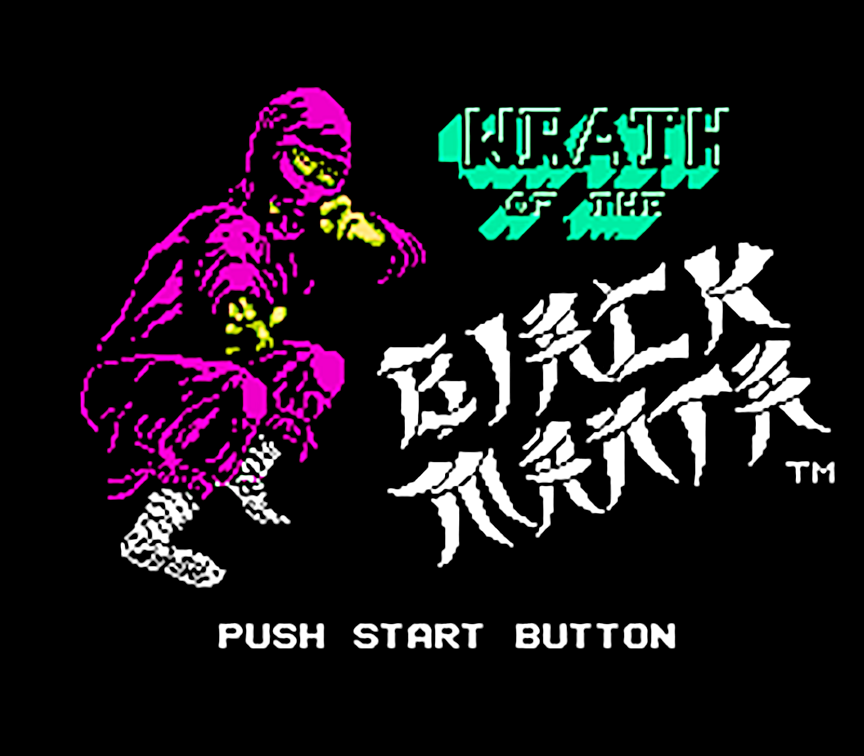
 children in New York City, the apparent bastion of all evil and where the most heinous crimes take place in the video game world. A drug fiend named El Toro is hellbent on turning these children into addicts and it’s up to you and your ninja skills to make Toro get down or lay down with the War on Drugs.™
 The fact that most of the action is ripped off from the infinitely better and more interesting Ninja Gaiden doesn’t help here because you’re going to die a lot from terrible jumping and those aforementioned hits from enemies. The soundtrack also does Manta no favors as it’s just barely serviceable. Even the art is ripped off from somewhere else: Word on those mean streets of
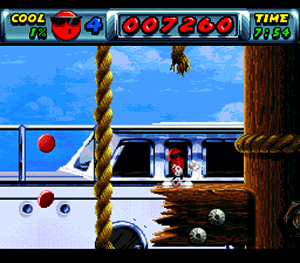 throughout 11 levels in cages. Why its friends are trapped, we’ll never know but it’s up to Spot to rescue them and lecture you about not drinking dark sodas. Spot’s traversal through these 11 levels is nothing short of amazing despite the rampant product placement. It’s surprisingly good, with solid controls that don’t make controlling Spot a chore, and competent simple mechanics that don’t get in the way: It’s mostly jumping and shooting magical sparks at enemies and barred gates. The life system — hilariously denoted by an ever-peeling and deteriorating picture of Spot — is more than generous and there are helper power ups galore to get through levels. The levels themselves have a lot of depth and are timed just right with enough time to explore or get the bare minimum experience in the search for Spot’s missing friend.
 While Spot might be on a product placement-filled journey, it’s a lushly drawn trip. Cool Spot is no slouch when it comes to the audio-visual department. The backgrounds are drawn with Spot moving through an obviously human world at about 25 percent of the size of everything else. It isn’t big at all but the world surrounding it is and it shows in the sheer scale, though my only gripe with the game comes here: The backgrounds, while beautiful, are recycled except for a few stages. At least the first three stages are repeated and reused, just with new stage names and some recoloring in spots.
 animals that are in one of four locations scattered around the landscape. Four animals will be in these locations with options to talk to you and request items; whether you choose to give them the specific items they request or just chat it up for experience points is up to you. Also new are the aforementioned experience points. Each animal has a meter that gauges their friendship level with you. The higher the level, the more rewards they give in exchange for items they request. The rewards are also new, usually in the form of Leaf Tickets and raw materials that are used in crafting furniture and clothes that can be used to decorate your camp site and
  For a longtime Animal Crossing player, the fun in Pocket Camp is immediately there but not without some caveats. After a certain point, the in-game currency of Bells ceases to be a problem. While scarce in the early going, Bells aren’t an issue once the final upgrade for the
 for either the novice or the advanced,
 modes to choose from. If you’re not informed, you might be a little lost trying to understand just where you should start. With a varied plate to choose from, at the very least the modes are interestingly designed and add value to an already-packed game.
 Festival takes that concept and turns it on its head. With Festival, you’re tasked with moving around a typical Animal Crossing town in the form of a large board game. The town is transformed by spaces that can be events, Stalk Market sale stops and visits from the usual assortment of guests that visit a normal town in the franchise.
  the game. For example,
 a nightmare and a chore to actually control. The Fighter flaps his arms to stay afloat and even with both balloons still present, this is extra hard to do and maintain. More often than not, I don’t lose balloons because an enemy popped them; it’s because I landed in the water, was eaten by the large fish or steered myself unwittingly into the lightning I was desperately trying to avoid. Precision flying this is not. To get a sense of what it’s like to control the Fighter, imagine if the horrible Ice Climbers were flying instead of jumping terribly up a mountain.
  And while the game is barely playable, the soundtrack also manages to squeak by in presentation. It is a sad day when I declare that a soundtrack from Metroid sound director Hip Tanaka is irredeemable. There is nothing that makes me want to listen to this, and nearly everything that Tanaka has created gets high marks from me. The songs aren’t memorable, there are few songs there anyway, and the lack of varied sound effects is disconcerting. Add the soundtrack woes to an underwhelming graphical palette and the game overall is a mess.
 further bubbles. After a certain number are cleared, the ceiling of the well lowers, inching closer to a visible line. Once the line is crossed with a bubble, the game is over. Basically, it’s reverse Tetris with bubbles instead of lines. The trickiness in mastering the game comes in popping the bubbles. There are different techniques to achieving the results that you want, but it really comes down to knowing how to aim and learning the fabled bankshot off the side of the well.
 With its simplicity in learning, Bust-A-Move quickly distinguishes itself as fun to play. I requested the game for my 14th birthday, and I’ve had a blast playing the original since. There are other games in the series, but this one is the best out of all of the sequels and spinoffs of the series. The controls aren’t too stiff, though sometimes I have complaints about the particular way a bubble bounces or sticks a little too easily to the first bubble it comes close to. Yet, the controls aren’t horrible.
 play begins: For every line cleared, a small amount of energy is added to a magic meter. Fill up the magic meter and you get what we’ve termed at