Hearing the name Track & Field II easily creates powerful nostalgia in me. I was a young girl learning the ins and outs of an NES in 1989 when my older brother, Tony, brought home the Olympic contest title. It was the last year that we lived in the same house and had time to sit down and play video games together. That was the year that I learned what it meant to duel an older sibling who had far better hand-and-eye coordination and reflexes and why teenagers seem to do much better at games than little kids.
I’m no Olympic athlete so I’d rather try my hand at the digital versions. Track & Field II offers a virtual bounty of events from which to choose, and all of them are pretty faithfully recreated from their original counterparts. There are 12 events to choose from, with three that can be chosen in different modes or as special events.
The events, ranging from hurdles to gymnastics and swimming, are fun to try but frustrating to learn the nuances. It took consultation with Tony, an NES Max controller and many years to get the hang of certain events. This is mostly because there wasn’t a lot of info out there in the days before the Internet and because, again, I had terrible untrained coordination and reflexes. Even today, with a wealth of tips out there, it’s still hard to get a bull’s‑eye in the archery, and it’s been nearly 30 years. Graphically, there’s a few things to look at, especially for an NES title. It’s not going to set the world on fire but the graphics are fine for the time period and don’t detract from the overall experience. The music, while not especially memorable, is still serviceable. It’s not something you’re going to be humming well after you’ve put down that turbo controller, but it’s not bad, either. A lot of the tracks are well done and fit the general mood of the event you’re participating in. There are a lot of sound effects in the game and they are generally what make the game what it is.
The nostalgic factor is what keeps me coming back to what is a generally frustrating game. That nostalgia is what turns a potentially controller-throwing hurdles event into a first-place triumph over a notoriously hard A.I. that likes to punish at every chance.
It’s my chance to feel like the Olympic champion that I will never be.
I don’t believe there is anyone who reads GI who doesn’t know that I don’t care for Donkey Kong. By now, it should be painfully obvious that I don’t care for the simian’s retro exploits or his more recent outings, either. It’s not that I don’t respect what the great ape has done for gaming; it’s more that I feel he gets credit for mediocre-to-horrible games. Donkey Kong Jr. falls on the lower end of the spectrum.
Much the same tripe as the original, you’re tasked with saving someone by moving across hell and high water. But wait, this time it’s different! No, you aren’t saving Pauline this time around; no, you’re Donkey Kong Jr., the scion of Kongdom saving your incorrigible father from the clutches of evil human Mario. The fact that another ape has to save his parental figure from Mario in a complete role reversal begs several questions: Where was Junior when his father was kidnapping innocent maidens and running rampant? Why would Mario even bother to kidnap the great ape in the first place? Sure, there’s the motive of revenge, but you’re never going to get your question answered, try as you might. You just have to accept that DK needs saving and it’s up to you, his reliable offspring, to do the job.
Hoping that your adventure in saving your father is worth it, the game tasks you in utilizing a jumping and climbing mechanic that may or may not work, depending on where you are height wise. Any fall more than a few pixels high will kill you, which makes about as much sense as the kidnapping caper you seem to be embroiled in. Whoever had the bright idea to make jumping a chore and maneuvering your ape around impossible obviously didn’t get that this was a bad design decision immediately. Seeing as though they are the only skills your ape has, it would have been a little bit wiser to make those work well. Instead, you’ll watch Junior repeatedly get eaten alive by crocodiles (we’re not sure why a plumber would employ these dangerous live creatures to kill an ape), nailed by random falling objects and fall to his obvious and horrific death, all because he’s underdeveloped at jumping and climbing.
And while you’re witnessing this obvious act of poaching, it’d be wise to use some headphones. The music, much like the original game, isn’t the greatest and it will get monotonous immediately. Donkey Kong Country this isn’t.
Your best bet is to try the game just for the nostalgic factor in seeing a pretty rare character; Junior was last seen, by my count, in Super Mario Kart for the SNES. He isn’t putting in too many other appearances and maybe, just maybe, it was this trip out of the jungle that convinced him to let his father do all of the adventuring in the family. This barrel isn’t full of laughs or a blast.
Previously, I reviewed the first game in Capcom’s critically acclaimed series Onimusha, where historic figures and moments in Japanese history were mixed with action/adventure gaming, third-person combat and brief moments of puzzle solving. After playing the first game, I wondered if the second installment would keep the successful formula and raise the bar for future installments. When I received Onimusha 2: Samurai Destiny, I put on my custom-made samurai armor and prepared to have my questions answered.
Onimusha 2 continues the plot of chosen warriors working to prevent Oda Nobunaga from unifying Japan through the use of demons called genma. Set 10 years after the first game, Nobunaga has risen to power despite the defeat of his demonic benefactor Fortinbras, who was stopped by original protagonist Samanouske Akechi. With Samanouske in hiding to perfect his new demon slaying abilities, it’s up to Jubei Yagu to take up the sword and acquire five legendary orbs and use them to stop Nobunaga before his dark plans of conquest becomes reality and demons become the dominant species of Earth instead of man.
Gameplay in Onimusha 2 remains the same but does have some new elements. During combat with enemies, you can still fight through enemies, but if timed correctly, Jubei can perform “Issen” (lighting slash) on various enemies, allowing him to continue forward, giving him a brief minute to defend himself or retreat. Another element is the requirement to solve certain puzzles to obtain certain items or gain access to certain areas. For these puzzles, I highly advise utilizing patience and strong memorization as they have a much stronger effect in Onimusha 2 than in the first game. The final new element is role playing that enhances the storyline. Jubei can not only interact with non-playable characters, but also gain allies who will give information or assist him in boss battles provided he is in constant contact with them or if his allies are not involved in their own plans to defeat Nobunaga. In addition to new allies, you will notice that Jubei is normally equipped with his sword, but can acquire weapons such as bows and arrows, a matchlock gun and other weapons that use the power of natural elements. Jubei does have two other advantages to help as well: The ability to temporarily transform into Onimusha with enhanced attack power; and, the power to acquire various souls without the use of a ogre gauntlet to upgrade his armor and weapons.
The controls will not present any level of difficulty especially if the Dual Shock analog controller is used. You can appreciate the quality of the characters’ movements in gameplay and in the cut-scenes which may make one wonder if they are playing a samurai adventure game or watching a movie.
The music performed in this game is excellent as Capcom’s sound team always brings their best efforts, guaranteeing that the music will be a treat. If you enjoy instrumental Japanese themes, you’ll probably love the soundtrack.
Onimusha 2: Samurai’s Destiny did exceeded my expectations for a game to be considered a true samurai masterpiece. This not only shows that Capcom can unleash their brilliance if they really try, but also shows other developers that in order to bring a superb gaming product involving various elements of Japanese culture, they must willfully present historical elements properly while crafting a high quality storyline. I can not wait to start the next chapter of the Onimusha series where the next destined hero strikes another blow to Nobunaga’s ambitions.
It’s one thing to trade off of nostalgia. And we all know Nintendo does that often and well. What we don’t often get to see is Nintendo using its history to change the way its games are played. Until now. That’s where Ultimate NES Remix comes in. The question is, do you want to play these remixed games again and at what price?
Remix takes a few of your favorites NES titles and adds different conditions to them in an attempt to spice things up a bit. In Super Mario Bros., for instance, you have to reach the goal in a certain amount of time or defeat a certain number of enemies within a time limit. That’s the mundane stuff in the beginning. Later edicts get harder the further down a game’s list you go so as to provide more of a challenge. Whether or not you enjoy these challenges depends sharply on whether or not you enjoy playing games you probably already have played and want to see something different within them. While the challenges may be different, there isn’t much else different about the games. The music and graphics from the 8‑bit era remain intact and about the only thing that’s changed is the slick modern packaging of the Ultimate Remix itself and the addition of leaderboards and championship mode. So, don’t come into this expecting depth or some magical upgrade to modern day standards of graphics.
If you enjoy the days of yesteryear and can and will pay $30 for a compilation challenge package, by all means shell out for Ultimate NES Remix. The challenges are amusing for the most part, and there are a few extras that make playing through the multitude of games offered (16 in all) a real treat. But take it with a large grain of salt and look at it for what it is: A chance to drag the original NES games out that you loved as a kid, more than likely, to get a piece of your now-adult wallet. Ultimately, this could have been a lot more.
The situation may have changed slightly, but the premise is still the same in Katamari Forever, the fifth game in the quirky series. Whether or not you’re into the “if it’s not broke then don’t fix it” method of gaming will determine if you can stand another trip to the cosmos with a katamari.
Just in case you haven’t played a game in the series, let’s get a refresher. Katamari titles involve rolling up a sticky ball with everyday objects to increase the ball’s size. The larger the ball, the more pleased someone is — usually the King of All Cosmos. That’s because the king is an idiot and routinely destroys something related to his job of protecting the cosmos. His lack of common sense and coordination usually means the Prince of All Cosmos — that’d be you, the player — has to create new stars and reconstruct the cosmos. This premise has worked for the past four games, and it’s really no different storywise except for the addition of the cousins to help in appearance only (added in We Love Katamari) and the fact that the king has been replaced temporarily by the Robot King of All Cosmos. Absurdity thy name is Katamari.
Nothing has really changed, mechanics-wise, either. There are a few additions to the repertoire of the Prince, such as the Prince Hop and the King Shock, but otherwise you’re still rolling along to pick up items to make your katamari grow. The series isn’t known for its growth and this is a major reason why. While it’s easy to control the Prince and maneuver the Katamari, there still should be some innovation at this point, five games in.
The soundtrack also suffers from stagnation. Katamari Damacy, the first game in the series, was known for having a great soundtrack. As a matter of fact, we’ve lauded the soundtrack relentlessly throughout our lifespan at GI. But try as we might, we’re still trying to understand why there isn’t as much creativity used in the musical portion of a game that conjures so many different creative thoughts. The music of the first game inspired so much, yet by the time of Forever, it seems that well has grown dry. It’s still a good soundtrack, but I was expecting more from this.
Overall, if you still love picking up a controller to save the cosmos and create katamari, you’ll probably be working to stop the Robot King of All Cosmos. Otherwise, you’re not really missing anything you haven’t already seen. Keep rolling by this one if you want a fresh experience.
There are always games that come with a certain amount of hype. These are the titles that everyone raves about but wind up on your never-ending pile of shame. You’ll probably buy it but never actually get around to playing it or playing it long enough to see what all the fuss is about. LittleBigPlanet is one of those such games.
Quirky is the first adjective I’d use to describe the platforming game featuring Sackboy, an anthropomorphic creature that’s featured front and center at the heart of the game. Sackboy can be Sackgirl as well, and that’s part of the charm of the game. It can be whatever you want it to be and do just about anything you want it to do, in the name of getting from point A to point B. The quirkiness comes in the fact that the environment in which it does so is all about Play-Share-Create. The levels of LittleBigPlanet are meant to be user-created and shared for online play among the LBP community, so the depth of the game is immediately obvious and worth the price of admission alone.
Controlling Sackboy/girl is simple, yet not without its problems. It’s much like playing any platformer of the past 20 years and the control scheme is simple and intuitive in letting you figure out what to do and how to apply it later. Where it falters is the jumping mechanics. While obvious and simple, the jumping does feel slightly off and floaty, which is a problem in a game that relies on that mechanic to carry it. It’s annoying to have to re-do sections of a level solely because of a missed jump, and that detracts from the core experience. While the mechanics could use tweaking, not much else needs work. The soundtrack is fantastic and fits the game perfectly. It’s a good mixture of indie folk and pop, and it immediately reminds of the brilliance that is Katamari Damacy. The graphics are also in the realm of perfect and evoke a certain sort of charm that begs more playthroughs just to see what developer Media Molecule could come up with next. It’s breathtaking and simplistic, like a child’s world come to life, and begs to be admired.
LittleBigPlanet is one of the few games of the past few years that demands to be played and warrants purchase of system just to play it. If you haven’t bothered to play it by now, you need to stop what you’re doing and get on it. It has its minor problems but they’re nothing to keep you from enjoying what’s considered a masterpiece. It’s worth every moment of its Play-Share-Create moniker.
In previous installments of Otaku Corner, I reviewed manga based on Capcom’s Devil May Cry. Ever since DMC’s arrival in 2001, it has grown from a critically acclaimed series to written and visual adaptations in comics, written novels and other various merchandise. Originally set in the Resident Evil universe, because of technology restraints and an expanding reverse storyline from Resident Evil, the series was ported to the PlayStation 2. Having enjoyed experiencing the manga’s action, I wondered if I would feel the same when I played the first DMC game? I was about to find out.
Devil May Cry has elements that are similar to Resident Evil; the only difference is that you will be dealing with supernatural enemies instead of those who were created by unethical scientific experiments. You assume the role of Dante, a demon hunter/investigator who uses his skills to exercise demons for profit and to avenge the loss of his family from said creatures. One night while working, Dante is hired by a mysterious woman named Trish, who after a brief but amazing test of Dante’s skill, hires him to go to an abandoned castle where Mundus, the demon who is responsible for the death of Dante’s family, is planning a return from hell. Unknown to our badass hero, he has taken on a a job that starts out as an opportunity for vengeance, but soon will unlock an ancient birthright and his true destiny as mankind’s newest protector against demonic forces.
Gameplay in DMC is a complete 180 from Resident Evil as the battle style is more melee combat that running and hiding from zombies. I found the controls pretty easy to use, thanks to the analog sticks that allow plenty of free movement to jump and take full advantage of Dante’s sweet combat moves. You will love it when Dante gets to business immediately with use of his twin handguns that can infict damage rapid-fire style and his awsomely designed sword Alastor that can be upgraded to unlock new attacks. He also has a BIG trump card to really make the demons howl with the use of “Devil Triggers” (think Goku or Vegeta going Super Saiyan with an arsenal of weapons and being in god mode).
The graphics are beautiful as Capcom developed a great game engine and made great use of the PS2’s technological capabilities to bring out the action without using the god-awful camera angles found in Resident Evil. I personally liked how each cutscene brought DMC’s storyline together without any over-the-top drama. The enemy variety is good, too, ranging from demon marionettes to giant owls and other demonic creatures. I enjoyed the voice acting because it was not forced, flowing in sync with the game’s plot. I am proud to say that I would definitely replay this game when I’m feeling like I want to rip some demons apart.
Devil May Cry is a standout original game that is worthy of its praise from gaming critics the world over. I find this another testimony to the fact that Capcom can do themselves and their customers justice by being true to their craft. I was pleased with my first DMC gaming experience and await more in future installments of this series.
MMX5 takes place several months after the events in Mega Man X4, during which the giant space colony Eurasia has been taken over by an unknown reploid known as Dynamo as it was undergoing extensive repairs. As a result, a computer virus infected Eurasia’s gravity control systems, sending it on a collision course with Earth. At the same time, Sigma and his new band of Mavericks have taken control of various areas that have equipment capable of preventing Eurasia’s fall, and he has also launched his own virus across the globe. X and Zero, under orders from their new leader Signas, must go to those areas to acquire the equipment needed to stop Eurasia, and send Sigma back to the scrap heap once more where he belongs.
MMX5’s gameplay remains the same as any regular action-adventure game. You can chose between using X and Zero, who each have unique abilities. I chose Zero because of the option to use his Z‑Saber and Z‑Buster as more effective combat tools, and also because of his stronger jumping abilities. MMX5 allows both characters to be swapped out during the stage select screen, provided you choose before time runs out. This adds freshness to the gameplay, keeping the game from being too mundane or too comfortable for a chosen character.
I liked the fact that there are new armors in the game that X can start off with. The Gaia armor from MMX 4 is less powerful but still gets the job done. You can find other armor sets that will give you an advantage, with good old Dr. Light providing insight about them. He has also made a special armor for Zero that you will find later on. I also want to note that if players pay close attention, there will be some background scenes in MMX paying tribute to classic Mega Man and Mega Man X games.
The plot of the game, while a good storyline point with stopping Eurasia, may frustrate you because you would have to defeat the first four Mavericks and later be told that two were developed simultaneously without previous knowledge of both plans. I also questioned the developer’s method of stage planning when they placed Dynamo in nearly every mid battle to delay either X or Zero without any strong challenge, and I questioned why, during Duff McWhalen’s stage, it takes a huge amount of game time to fight off a sub-boss that required running and firing just to keep it at bay.
Despite some frustrating issues, MMX5 is a great game to kill time with and shows how — with proper care and fresh ideas — a gaming franchise can still be relevant. Get the picture, Capcom?
Mega music
Capcom always had a creative knack for naming Mega Man adversaries. Mavericks in X5 are based off of the original band members of the rock group Guns N’ Roses.
Grizzly Slash — Slash
Squid Adler — Steven Adler
Izzy Glow — Izzy Stradlin
Duff McWhalen — Duff McKagan
The Skiver — Michael Monroe
Axle the Red — Axl Rose
Dark Dizzy — Dizzy Reed
Mattrex — Matt Sorum
A life of farming is never simple. Ask any farmer and they’ll tell you: It’s a tough, tough job that requires before-dawn rising and at-dusk retiring that repeats itself over the course of many a day. There’s also the fear of Mother Nature wrecking your livelihood and outside forces such as other humans stealing from you and running you into ruin. But, thankfully, you can avoid all of that and experience the joy of living off the land at its finest, digitally if you so choose, thanks to Natsume’s Harvest Moon: Back to Nature. And, if you play your cards right and take time to pull yourself away from digging up your ground, you can find yourself a certain Mrs. to share the farming duties with as well.
Back to Nature is the best game in the long-running series. I say this with confidence because it’s one of the only titles in the series to have been remade multiple times with the same setup, just different characters. Every modern Harvest Moon title takes its cue from Back to Nature, as well. The main goal, which stays the same throughout the series, is to take a farm that’s fallen into disrepair and make it into a profitable bastion of hard work and success. Your character works to accomplish this by pulling up his bootstraps and putting in a little elbow grease with little to no help from anyone else, aside from the gnomes he meets tucked away in the crease of the town.
Speaking of the town, you’re tasked with meeting folks and forging some type of relationship with them so that you are considered neighborly. The town’s set schedule makes for interesting interactions and a type of schedule planning not unlike Animal Crossing. While you’re working to save your farm and chatting up the townsfolk, you’re given a third task of finding a suitable lass in town to wife up. If you can manage to put a ring on it by wooing your intended (there are five lovely ladies that you can choose from to pursue with varying likes and dislikes), you’re all but guaranteed to earn your place in the town and be allowed to stay.
Back to Nature is deep, extremely deep. So much so that it takes quite a bit of time just getting the farm up and running in a proper manner that you might make money to sustain it. And that’s mission accomplished for Back to Nature: Get you involved and thinking hard about what it is you want to accomplish in your town. That level of interaction is simple to begin with, and with decent controls it doesn’t get too much harder to maintain. It’s one of the things that I love about Back to Nature. It doesn’t press too hard about mechanics and there’s a wealth of information within the game about crops and caring for animals that can help you maintain a comfortable way of life within the game. But sometimes, the level of comfort you want isn’t always within reach.
While I praise the controls, the effect isn’t always beneficial for you. The game is hard in the beginning, sometimes too hard for its own good. Take, for example, the fact that you arrive in town with basically nothing but the clothes on your back. You’re expected to succeed and settle down there but you have nothing tying you there very much. What’s to say that your player character doesn’t decide that it’s too much, packs up shop and goes home? It’s not very realistic with some of the things you’re tasked with doing, and starting with absolutely no money and trying to rebuild a farm is impossible with no cash flow.
My next problem comes with the cash opportunities afforded in the game. Without cheating, it is nearly impossible to become successful and well off. This leads into a larger problem with the way time is structured in the game as well. While the time aspect has to be different than real time, an entire day should not pass within nearly 30 minutes. It’s extremely hard to get much accomplished in the early going and it demands that you must have a routine in place quickly or risk being left behind. Sure, you’re given a year or two to get things together but it’s hard to make things work on the farm, court a girl and participate in town activities all at once in the short amount of time that passes as a day.
Couple it with the schedule given to the town and there’s a time management problem just waiting to happen. The controls sometimes leave a lot to be desired, too. More than once I’ve had a bucket that I’ve filled with goodies from my plot of land empty just far away enough from a bin that it went wasted. And more than once I’ve been angered by loss of income because it’s on the ground and not able to be reclaimed. But that’s a fact of life in Harvest Moon titles, I suppose.
Otherwise, Back to Nature is a great simulation of farm life. It’s a good way to play a dating sim and life sim all at once with very little consequence for poor choices. Getting back to nature is an idea all of us need to think of at least once, even if it is to digitally pair off and make a fast dollar.
Back to basics
Back to Nature, released in 1999 for the PlayStation One, has been remade several times. The first remake was released for Game Boy Advance as Harvest Moon: Friends of Mineral Town in 2003. Friends of Mineral Town was expanded with a side story, More Friends of Mineral Town — which allows playing from a female farmer’s perspective — in 2005. These were later ported as Harvest Moon: Boy & Girl for PSP in 2005.
You know, once in a while, a game comes along that is just full of fun stuff and guilty
William Harrison, GI contributing editor
pleasures that make you feel all warm and fuzzy inside. Ladies and gentlemen, this is that game. Thief is a game that when I first heard about the original — way back when it was only available for PC — I thought it was one of those games I would have liked to play but didn’t think it would be fun. Man, was I ever wrong.
Thief places you in the role of master thief Garrett as he works his way through a city run by a greedy and bloodthirsty Baron and his guard known as the WATCH. Use the shadows to your advantage and truly make what is theirs … yours.
Eidos/Montreal and Square ENIX put forth a great effort in making this game a reality and bringing it to home systems. Thief is actually the fourth incarnation of the series, set during the time period around the same time as the Black Plague, I think; they don’t really tell you when it’s set or where it is relevant to any time period. I only say during the time of the Black Plague because of the disease that runs rampant called the gloom, which is a lot like it.
The stealth gameplay is the main reason why I’m a huge fan of this game. I like the fact that it’s a major part of the game and there is an achievement for making it through the game unseen. There is the rating system where I seem to always straddle the line between ghost and opportunist in my quest to see if I’m still as sneaky in stealth games as I claim to be.
As of press time, I haven’t finished Thief but the story and the free roaming aspect are awesome. At times, I wander from the story to explore, roam aimlessly and rob people blind just like in real life.
The city and the characters are beautifully designed and rendered but it seems to be missing something. The music — as far as atmosphere goes — is OK but it seems that you can’t really hear it. And, a lot of times the interactions between characters is almost a joke because you can sometimes barely hear what a NPC or yourself are saying. Apparently, subtitles are a bit of a must to catch everything being said.
I’m not quite sure how the old Garrett matches up to the new Garrett since I haven’t played the PC titles but hopefully it’s not too far off. I really do enjoy this game, but it seems that it isn’t really all that long, at least not when you get into the story-specific missions. There is still a free roam element there but there are also points where you can’t go back and that seems like it’s punishing the player and slapping you saying, “You want to explore?! NOW!? The fate of the world is at stake!!”
Thief is a really good stealth, make-you-feel-guilty-in-a-good-way sort of game and should definitely be played by all. The fact that it’s the fourth game but also a reboot of the series is fine, but the fans of the older games may have a problem with the differences. Sound issues aside, this is a hell of a steal.


 it meant to duel an older sibling who had far better hand-and-eye coordination and reflexes and why teenagers seem to do much better at games than little kids.
 many years to get the hang of certain events. This is mostly because there wasn’t a lot of info out there in the days before the Internet and because, again, I had terrible untrained coordination and reflexes. Even today, with a wealth of tips out there, it’s still hard to get a bull’s‑eye in the archery, and it’s been nearly 30 years. Graphically, there’s a few things to look at, especially for an NES title. It’s not going to set the world on fire but the graphics are fine for the time period and don’t detract from the overall experience.
 The music, while not especially memorable, is still serviceable. It’s not something you’re going to be humming well after you’ve put down that turbo controller, but it’s not bad, either. A lot of the tracks are well done and fit the general mood of the event you’re participating in. There are a lot of sound effects in the game and they are generally what make the game what it is.

 hell and high water. But wait, this time it’s different! No, you aren’t saving Pauline this time around; no, you’re Donkey Kong Jr., the scion of Kongdom saving your incorrigible father from the clutches of evil human Mario. The fact that another ape has to save his parental figure from Mario in a complete role reversal begs several questions: Where was Junior when his father was kidnapping innocent maidens and running rampant? Why would Mario even bother to kidnap the great ape in the first place? Sure, there’s the motive of revenge, but you’re never going to get your question answered, try as you might. You just have to accept that
  Instead, you’ll watch Junior repeatedly get eaten alive by crocodiles (we’re not sure why a plumber would employ these dangerous live creatures to kill an ape), nailed by random falling objects and fall to his obvious and horrific death, all because he’s underdeveloped at jumping and climbing.
 where historic figures and moments in Japanese history were mixed with action/adventure gaming, third-person combat and brief moments of puzzle solving. After playing the first game, I wondered if the second installment would keep the successful formula and raise the bar for future installments. When I received Onimusha 2: Samurai Destiny, I put on my custom-made samurai armor and prepared to have my questions answered.
 perform “Issen” (lighting slash) on various enemies, allowing him to continue forward, giving him a brief minute to defend himself or retreat. Another element is the requirement to solve certain puzzles to obtain certain items or gain access to certain areas. For these puzzles, I highly advise utilizing patience and strong memorization as they have a much stronger effect in Onimusha 2 than in the first game. The final new element is role playing that enhances the storyline. Jubei can not only interact with non-playable characters, but also gain allies who will give information or assist him in boss battles provided he is in constant contact with them or if his allies are not involved in their own plans to defeat Nobunaga.
 In addition to new allies, you will notice that Jubei is normally equipped with his sword, but can acquire weapons such as bows and arrows, a matchlock gun and other weapons that use the power of natural elements. Jubei does have two other advantages to help as well: The ability to temporarily transform into Onimusha with enhanced attack power; and, the power to acquire various souls without the use of a ogre gauntlet to upgrade his armor and weapons.
 While the challenges may be different, there isn’t much else different about the games. The music and graphics from the 8‑bit era remain intact and about the only thing that’s changed is the slick modern packaging of the Ultimate Remix itself and the addition of leaderboards and championship mode. So, don’t come into this expecting depth or some magical upgrade to modern day standards of graphics.
 repertoire of the Prince, such as the Prince Hop and the King Shock, but otherwise you’re still rolling along to pick up items to make your katamari grow. The series isn’t known for its growth and this is a major reason why. While it’s easy to control the Prince and maneuver the Katamari, there still should be some innovation at this point, five games in.
 much like playing any platformer of the past 20 years and the control scheme is simple and intuitive in letting you figure out what to do and how to apply it later. Where it falters is the jumping mechanics. While obvious and simple, the jumping does feel slightly off and floaty, which is a problem in a game that relies on that mechanic to carry it. It’s annoying to have to re-do sections of a level solely because of a missed jump, and that detracts from the core experience.
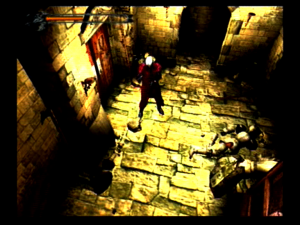 unethical scientific experiments. You assume the role of Dante, a demon hunter/investigator who uses his skills to exercise demons for profit and to avenge the loss of his family from said creatures. One night while working, Dante is hired by a mysterious woman named Trish, who after a brief but amazing test of Dante’s skill, hires him to go to an abandoned castle where Mundus, the demon who is responsible for the death of Dante’s family, is planning a return from hell. Unknown to our badass hero, he has taken on a a job that starts out as an opportunity for vengeance, but soon will unlock an ancient birthright and his true destiny as mankind’s newest protector against demonic forces.
 The graphics are beautiful as Capcom developed a great game engine and made great use of the PS2’s technological capabilities to bring out the action without using the god-awful camera angles found in Resident Evil. I personally liked how each cutscene brought DMC’s storyline together without any over-the-top drama. The enemy variety is good, too, ranging from demon marionettes to giant owls and other demonic creatures. I enjoyed the voice acting because it was not forced, flowing in sync with the game’s plot. I am proud to say that I would definitely replay this game when I’m feeling like I want to rip some demons apart.
 chose between using X and Zero, who each have unique abilities. I chose Zero because of the option to use his Z‑Saber and Z‑Buster as more effective combat tools, and also because of his stronger jumping abilities.
  armor from
 relationship with them so that you are considered neighborly. The town’s set schedule makes for interesting interactions and a type of schedule planning not unlike Animal Crossing. While you’re working to save your farm and chatting up the townsfolk, you’re given a third task of finding a suitable lass in town to wife up. If you can manage to put a ring on it by wooing your intended (there are five lovely ladies that you can choose from to pursue with varying likes and dislikes), you’re all but guaranteed to earn your place in the town and be allowed to stay.

 Eidos/Montreal and Square