

Metroid Dread a return to form for veteran series

That foreboding sense of … dread. The anticipation of walking into an unknown room and possibly finding a secret. It’s the stuff many old-school gamers and Metroid fans like me cut our teeth on growing up with Metroidvania games. The original Metroid set the tone, but Super Metroid is the house of cards that everything in the genre rests on. And Metroid Dread, while an admirable attempt to recreate that nostalgic feeling, is a few missiles short.
Don’t misunderstand me: I love Metroid Dread. It’s the return to form that we all expect of a Metroid game, and you can tell that within the first five minutes. The opening cinematic picks the story up after Fusion where Samus Aran, the baddest bounty hunter in the known universe, has simultaneously solved the X Parasite threat and ushered in galactic peace once again. Despite that, the Galactic Federation receives verified proof that the X are not extinct and sends EMMI (Extraplanetary Multiform Mobile Identifiers) to the planet ZDR to investigate the mystery of why the X Parasite has reappeared. Soon after the EMMI land, all contact is lost with them. Ms. Aran is sent in to investigate their disappearance, and shortly after landing, finds herself in combat with a mysterious figure that resembles a Chozo. Given that the Chozo other than herself are also extinct, it’s an even deeper mystery that Samus is determined to solve.
The story is interesting, and I was genuinely invested in learning about the EMMI and what they found on the planet. I was even more intrigued about the Chozo warrior because I’m well-versed in the lore of Metroid and anything that calls back to Super Metroid and Samus’ origin story is going to have my attention. It also references Metroid Fusion, obviously, and parts of Metroid II: Samus Returns — which is the excellent remake of Metroid II: The Return of Samus. Leaning on the older story is a smart move because you’re probably going to go back and play the older games and the remake, and you’re going to buy into the story of the current game a little bit easier.

What isn’t a little easier, even on the easy difficulty level, is the combat. Listen, I’m a Super Metroid expert and I can even claim beating the original Metroid, but the first hour of Dread is hard. I got stuck on the second EMMI chase sequence and had to go watch a detailed demonstration of what to do because I just wasn’t getting it. And, yes, I love this about Dread. Metroid, at its core, is about exploration, problem-solving and figuring out things by trial and error. I’m doing that in Dread, though my old-man reflexes and patience are getting in the way. But this is what I want out of my Metroid game to a point. The other side of this, however, is that I didn’t care for the mad dash away from an all-powerful enemy in Metroid Fusion in 2002, and I don’t particularly care for the mad dash away from an all-powerful enemy in Metroid Dread now. That frantic feeling of not knowing what to do in a sequence that means instant death constantly is not a good one, and I had hoped that it wouldn’t return 20 years later, but here we are. I’ll figure it out and learn to live with it, I guess, but it’s not one of my favorite parts of the game.
One of the other things I do love about Dread is the atmosphere. The music hits the sweet spot of nostalgia and new with leitmotifs of Super and the original game mixed in, and the graphics are gorgeous. I’ve long been a fan of the music of Metroid, and this is just another masterpiece in the long history of the series. Also, Samus has never looked better. She’s more fleshed out with modern graphics, but my favorite heroine is simply stunning even in the stripped Power Suit. And while ZDR is no Zebes, it’s a deliciously dark environment that invokes the best part of brooding moody dark planet that fits right in Metroid lore.
 While I love a lot of Dread, there are some things that I don’t quite love. First, as a veteran Metroid lover, I can’t help but wonder why it took so long to get a side-scrolling version of Metroid again and why it followed Fusion after so many years. Dread is fantastic, but Fusion was not exactly Super, and Dread tries a little too hard to make Fusion work. I’d rather Dread had its own identity aside from the cleanup of Fusion’s mess.
And while we’re at it, Dread tries a little too hard to lean into Super’s legacy. It’s well-known that Super is our favorite game of all time. That is not a secret. However, unless you’re going to give me a full modern remake of Super, don’t tease me with something almost there.

Dread is a tease, a “what if we were to remake the greatest game of all time with modern controls” experiment. To quote the awful Ronin in Avengers: Endgame, don’t give me hope. Don’t give it to me halfway and then be like, naw, you know what? Let’s just call it Metroid 5 and we’ll revisit that Super remake later. This technically isn’t Dread’s fault, because it’s an excellent game and it’s giving me, the Metroid fan who didn’t want a first-person shooter Metroid, exactly what I’ve been asking for since Fusion. I’m not dinging Dread per se; I’m dinging Nintendo for being a tease and a terrible one at that.
Metroid Dread does almost everything right: The atmosphere is Metroid, the graphics are Metroid, the story is Metroid and the secrecy is Metroid. It’s a must-play if you’re into the series and even if you aren’t, you still need to experience it just to see how the grand dame of Metroidvania does her thing and creates perfection. It’s just that if you’re walking into this thinking you’re going to get Super Metroid levels of perfection, you’re going to be disappointed. It’s not Other M level of disappointment, but the layers of Super haunt the outcome. Then again, let’s face it: Nothing is going to touch Super’s level of nuance. And Dread is still fine for it. Dread nearly hits on every level, and it’s the side-scrolling Metroid adventure we non-first-person shooter fans have been waiting for. It’s just that you must be willing to look past the dreaded comparisons to Super Metroid to see its true finesse.

 item from Guile, which would help him defeat M. Bison. Third Strike boss Gill drives the plot overall, tying up the loose ends between
 after Mario Kart: Double Dash have begun referencing the previous tracks of yore, sometimes with varied results. Mario Kart 8 manages to gather a lot of stellar new tracks and some old that aren’t favorites but will suffice as entries. A lot of the older tracks are from more recent entries but make no mistake — they are there for the purpose of drawing you in to remind you of the good times and then send you on your merry way to try the new tracks. Tugging at my heart strings with a modern

 elements from the original platforming masterpieces Super Mario Bros. and Super Mario Bros. 3. Joining those are secondary greatest hit Super Mario World and the more recent hit New Super Mario Bros. U. All four games represent some crowning achievement for the everyday plumber and thus have some merit for making you revisit these set pieces to create your own masterpiece.
 nitial two and ultimately the majority of your creation library are unlocked via a time system that goes by days. You can speed it up, but it’s intended to make you the creator spend several days trying out the system and getting a feel for new elements in a paced environment. I can appreciate the sense of not wanting too many elements all at once, but the system is a little slow and frustrating when I have a million ideas that I can’t fully implement for several days initially.
 much like playing any platformer of the past 20 years and the control scheme is simple and intuitive in letting you figure out what to do and how to apply it later. Where it falters is the jumping mechanics. While obvious and simple, the jumping does feel slightly off and floaty, which is a problem in a game that relies on that mechanic to carry it. It’s annoying to have to re-do sections of a level solely because of a missed jump, and that detracts from the core experience.
 that has set the standard for today’s anime. Most of the awesome-level anime old and new has came from Japan’s world-renown Tatsunoko Productions. So, when I heard that Capcom was reviving its “Versus” series, I thought that Capcom was running out of gaming ideas. That was until it was announced that Tatsunoko would play a major role. I thought it was a joke, but I was in shock when the rumors were true and thus the question came about: What would happen if Capcom’s heroes met Tatsunoko’s heroes in a gaming forest? Tatsunoko vs. Capcom: Ultimate All-Stars for the Wii answered that question for me.
 It’s simplified even more thanks to the Wii’s Classic controller, GameCube controller, third-party arcade sticks and the regular Wii remote. You will love the character roster consisting of each companies’ top franchises such as Street Fighter, Rival Schools, Viewtiful Joe, Lost Planet, Darkstalkers/Vampire and Mega Man for Capcom while Tatsunoko is represented by Karas, Tekkaman, G‑Force and Yatterman. There are other characters that can be unlocked via use of money (Zenny) earned in each game, which also will allow purchase of alternate endings, costume changes and other unlockable surprises.
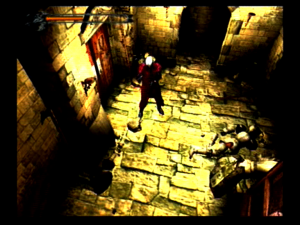 unethical scientific experiments. You assume the role of Dante, a demon hunter/investigator who uses his skills to exercise demons for profit and to avenge the loss of his family from said creatures. One night while working, Dante is hired by a mysterious woman named Trish, who after a brief but amazing test of Dante’s skill, hires him to go to an abandoned castle where Mundus, the demon who is responsible for the death of Dante’s family, is planning a return from hell. Unknown to our badass hero, he has taken on a a job that starts out as an opportunity for vengeance, but soon will unlock an ancient birthright and his true destiny as mankind’s newest protector against demonic forces.
 The graphics are beautiful as Capcom developed a great game engine and made great use of the PS2’s technological capabilities to bring out the action without using the god-awful camera angles found in Resident Evil. I personally liked how each cutscene brought DMC’s storyline together without any over-the-top drama. The enemy variety is good, too, ranging from demon marionettes to giant owls and other demonic creatures. I enjoyed the voice acting because it was not forced, flowing in sync with the game’s plot. I am proud to say that I would definitely replay this game when I’m feeling like I want to rip some demons apart.
 much more under the pretty coat of nostalgia. Injustice is deep, with plenty to keep the fighting game crowd coming back for more and just enough to pique the interest of casuals who don’t know much about fighting games but want to see who would win in a Batman vs. Superman battle.
 gorgeous and lavish in the game that’s already beautiful from the outset. The graphics step up from


 Xbox One, Xbox 360 and