

Pacific battles fly in 8‑bit form
Capcom’s warfighting 1940 series reminds me of the good times when arcade gaming  ruled my weekends and I was fortunate to find some rare gems that later became gaming classics. During that time, I played 1942 in the arcade and on the NES and walked away from this experience with some valuable information: 1. The first game in a series may or may not guarantee future success; and, 2. The creators of some of our favorite games had to cut their teeth on low-tier games before they received the big breaks that made them what they are today. One of those games is 1942.
1942 is a vertical-scrolling shooter that takes place on the Pacific front of World War II. You take control of a P‑38 Lightning plane assigned to go to Tokyo and destroy the Imperial Air Force fleet.
Gameplay of 1942 is simple: You can move either vertically or horizontally. Consisting of 32 stages, the P‑38 will be challenged by Ki-61s, A6M Zeros, and Ki-48s with a long-range bomber known as G8N as level bosses. To give the P‑38 Lightning a fighting  chance against these planes, it can do air rolls or vertical loops. If you time your attacks right, some planes will drop upgraded firepower or an escort team of two smaller fighter planes to combat the relentless assault from planes that WILL attempt to knock you out of the skies, especially if you’re just taking off from your aircraft carrier.
While I liked 1942, there are some issues that annoyed me. Timing of movements, including the vertical drops and air rolls, must be precise because of the high chance of being shot down by enemy planes. Also, you must watch for attacking planes in front and behind as the Ki-48s are masterful at getting the unsuspected into close-area shootouts, which will reduce the number of lives quickly.
 The music quality of 1942 is an acquired taste as the repeated use of a snare drum made me think that Capcom phoned in a lackluster drum beat, which made me turn the volume down to continue playing. The challenge is decent since you will be on your toes to avoid enemy fire nonstop. It has strong replay value and would be a great time-killer as a nostalgia trip for arcade veterans. Also, it’s a great example for those who want to know how side-scrolling games played a major impact in the gaming world.
1942 serves not only as an icon in gaming’s hall of fame but also doubles as one of Capcom’s entries into the gaming world. It helps that 1942 was the start of looking at Capcom as an up-and-coming game company wanting to expand beyond its home of Osaka, Japan.
Fun facts:
-
- The P‑38, Ki-61, A6M and Ki-48 were actual war planes used heavily in the Pacific Conflict between the U.S. and Japan. The companies who built them — Lockheed Martin, Kawasaki, and Mitsubishi — are well-established in the defense industry and continue to play vital roles in various areas of aerospace technology.
- 1942 was Yoshiki Okamoto’s debut game for Capcom. He was also the original game designer of Konami’s Gyruss. Because of internal disputes involving pay, he was fired from Konami. After 1942’s success, Okamoto remained at Capcom where he played an important role in producing Final Fight, Street Fighter II and Biohazard/Resident Evil. He retired from game development for consoles in 2012 and is currently developing games for various mobile devices.
- The P‑38, Ki-61, A6M and Ki-48 were actual war planes used heavily in the Pacific Conflict between the U.S. and Japan. The companies who built them — Lockheed Martin, Kawasaki, and Mitsubishi — are well-established in the defense industry and continue to play vital roles in various areas of aerospace technology.

 and pretenders to the throne of the best local fighting game champion. In its place are home consoles designed to push the power of the arcade. Fighting game franchises have had to keep up or suffer irrelevancy or, worse yet, extinction. The earliest king of the genre, Street Fighter, has had a challenge of sorts: continue forward or go the way of its ride-a-longs of the ‘90s. Super Street Fighter
  for either the novice or the advanced,
  Fight locales associated with many of the characters are available with a great soundtrack accompanying them.
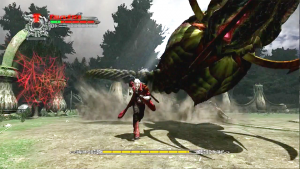 has changed for a more intense experience. Taking place in a remote island town called Fortuna, you assume the role of Nero — a younger version of Dante — who is a member of the Order of the Sword. The Order of the Sword is a militant religious organization formed to destroy demons based on the actions of the Demon-Knight Sparda, who rebelled against the demon underworld to protect humanity. At a recent ceremony to honor Sparda, Dante smashes though a skylight and kills the priest leading the ceremony, setting off a chain of events that would not only put Dante and Nero on a collision course with each other, but also would lead both demon-hunters through a greater mystery to find out the true intentions of the Order and to stop a more vicious plot of a demon-invasion.
 The excellent detail that is used in each level comes to life in the background and cinematic scenes. These were done with high definition technology that will make you feel like you are playing with a masterpiece of art instead of a video game. Capcom’s sound team brings their A‑game again. Each sound and vocal effect combined with Dolby Digital Sound gives an orchestral quality to the game. Capcom did a great job in voice and motion capture for
 protect his kingdom, finds out that his main lady Queen Sophia is captured by his once-trusted adviser, Achille. To make matters worse, Achille has developed a drill that has pierced the underworld, allowing him to create an army of undead monsters to terrorize the kingdom. All is not lost as is seems that as Maximo was free-falling, the Grim Reaper makes a deal for him to return to the living world in exchange for returning the lost souls to the underworld. Maximo accepts and begins his quest to free Sophia and restore the peace taken by Achille.
  Maximo retains the elements from Ghosts ‘N Goblins and Adventure Island but allows freedom to explore all of the stages thanks to its
 play begins: For every line cleared, a small amount of energy is added to a magic meter. Fill up the magic meter and you get what we’ve termed at
  The game shines in its visuals, which benefit from that Disney touch. The game is bright and colorful and designed in the way of Disney games and animation, meaning it’s top-notch through and through. The graphics are still good for an N64-era game and haven’t aged badly. The soundtrack has aged well, too, and is still one of the best of the era. Each character’s stage is memorably themed and stands out enough for you to remember it well after your game is over.
 tutorials for players to master Dante’s moves and his signature weapons. In addition to the tutorials, four different combative arts called “styles” are available to Dante, giving him various abilities to increase the power of various guns, striking weapons, dodge attacks, and unleashing hand-to-hand combat with devastating results. Once Dante defeats a certain boss, he will be able to use them in the form of unique, various weapons. There is a lock-on feature to directly target enemies that, with practice, will be a valuable tool to rip enemies apart. Also in the special edition, there are two modes of play: Normal, which is basic
 perform “Issen” (lighting slash) on various enemies, allowing him to continue forward, giving him a brief minute to defend himself or retreat. Another element is the requirement to solve certain puzzles to obtain certain items or gain access to certain areas. For these puzzles, I highly advise utilizing patience and strong memorization as they have a much stronger effect in Onimusha 2 than in the first game. The final new element is role playing that enhances the storyline. Jubei can not only interact with non-playable characters, but also gain allies who will give information or assist him in boss battles provided he is in constant contact with them or if his allies are not involved in their own plans to defeat Nobunaga.
 In addition to new allies, you will notice that Jubei is normally equipped with his sword, but can acquire weapons such as bows and arrows, a matchlock gun and other weapons that use the power of natural elements. Jubei does have two other advantages to help as well: The ability to temporarily transform into Onimusha with enhanced attack power; and, the power to acquire various souls without the use of a ogre gauntlet to upgrade his armor and weapons.
 of the board game mode and the character creation mode that plays out like an eroge simulation are some of the goodies that we’re missing out on in the U.S. There’s also the addition of three new characters: Ran, a photojournalist who uses her camera to attack; Nagare, a swimmer; and, Chairperson/Iinciyo, who leads the charge for Taiyo High School students to defend themselves. Other than these gifts, there’s not much different here than the first game. You’re still fighting to defend your chosen school, and there’s still fun to be had in a slightly deep fighting game system. There’s not too much different aesthetics-wise, in that there are a few new stages and new stage themes. The older stages are still here and it’s fun to play against the newcomers with older characters or a created character.
 I have two caveats with recommending the game to others. The first is the fact that it’s in Japanese mostly and reading is a must to get through the character creation and board game modes. That’s a bit much if you’re not into the language or know enough to navigate through menus. The other issue is the fact that, as usual, Capcom has seen fit to deny American gamers the best of a series,
 It’s simplified even more thanks to the Wii’s Classic controller, GameCube controller, third-party arcade sticks and the regular Wii remote. You will love the character roster consisting of each companies’ top franchises such as Street Fighter, Rival Schools, Viewtiful Joe, Lost Planet, Darkstalkers/Vampire and Mega Man for Capcom while Tatsunoko is represented by Karas, Tekkaman, G‑Force and Yatterman. There are other characters that can be unlocked via use of money (Zenny) earned in each game, which also will allow purchase of alternate endings, costume changes and other unlockable surprises.
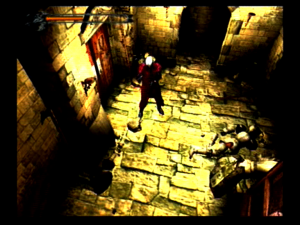 unethical scientific experiments. You assume the role of Dante, a demon hunter/investigator who uses his skills to exercise demons for profit and to avenge the loss of his family from said creatures. One night while working, Dante is hired by a mysterious woman named Trish, who after a brief but amazing test of Dante’s skill, hires him to go to an abandoned castle where Mundus, the demon who is responsible for the death of Dante’s family, is planning a return from hell. Unknown to our badass hero, he has taken on a a job that starts out as an opportunity for vengeance, but soon will unlock an ancient birthright and his true destiny as mankind’s newest protector against demonic forces.
 The graphics are beautiful as Capcom developed a great game engine and made great use of the PS2’s technological capabilities to bring out the action without using the god-awful camera angles found in Resident Evil. I personally liked how each cutscene brought DMC’s storyline together without any over-the-top drama. The enemy variety is good, too, ranging from demon marionettes to giant owls and other demonic creatures. I enjoyed the voice acting because it was not forced, flowing in sync with the game’s plot. I am proud to say that I would definitely replay this game when I’m feeling like I want to rip some demons apart.