

Mario’s greatest evolution 
Most of the gaming world would agree that Super Mario 64 is one of the greatest games of all time. I would agree also except for two things: First, the game gives me a tremendous headache after about 10 minutes of play; and, second, I’m not like most people.
See, where I have a problem with Mario 64 is where most people don’t have a problem. Don’t get me wrong; I love the leap forward that presents itself as soon as you boot up the game for the first time. I was — and still am — in awe of the wonderment that is seeing Mario in 3D after playing 2D Mario games for the majority of my gaming career. However, I’m not in concert with the idea that it’s one of the greatest games of all time. Why? Just because it was the first to fully realize a formerly 2D character in 3D splendor? Because it’s Mario and just because it’s Mario?
No, I can’t form my opinion or even include the game in the conversation of greatest game of all time just because of any of those things. There has to be some valid reasoning and while there are some great points for it, I’m not sold 100 percent.
Mario 64, graphically, is steps ahead of almost everything for the Nintendo 64. Note that I said almost.
Most games don’t hold a candle to Mario in fully realized 3D and, even with his polygonal block style as with most early N64 games, Mario still looks like a king. Peach’s  Palace is interestingly laid out and the graphical quality of the castle still blows away the competition 20 years later. Watching Mario run around, run and jump and be Mario but in a non-2D sprite is pure heaven for Mario lovers like myself.
But there’s that blockiness that I mentioned before. It’s obvious throughout and can be jarring from time to time. And for motion sickness sufferers like myself, the 3D is nigh unbearable. It’s all I can do not to vomit after 20 minutes, so my playtime is immediately limited because of the visuals. I should not be wanting to vomit after playing a Mario game.
 The soundtrack makes up for the illness-inducing gameplay. The soundtrack is fantastic and it’s worthy of a mainline Mario game, easily. From running around in the plains of Bob-omb Battlefield to traversing numerous obstacles to take on the King of the Koopas, Mario 64 is a dream come true in terms of audio pleasure.
And, this is, after all, the first commercial game where Mario actually speaks. It’s a joy to hear him squeal and squawk for the first time as he explores the various worlds.
With all of my negative sentiments about the leap from 2D to 3D for Mario, I still appreciate the masterpiece that is Mario 64. Groundbreaking and simultaneously frustrating?
Yes. But it’s frustration worth having even if it takes a tumble down my list of greatest games ever.

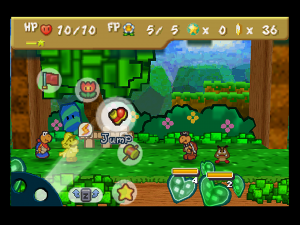 Mario fills that void nicely with an engaging tale of teamwork and camaraderie. I was most impressed with the depth of the characters and the deft way Intelligent Systems fleshed out the world of Mario and some of his never-before-seen allies who come from all walks of the Mario life.
  That kind of borrowing is the kind of thing that’s allowed and plays well within the context that Mario is the king of all that he surveys and even in his spinoff titles, he can still run with the best of the best, pay homage and still come out smelling like roses.
 it meant to duel an older sibling who had far better hand-and-eye coordination and reflexes and why teenagers seem to do much better at games than little kids.
 many years to get the hang of certain events. This is mostly because there wasn’t a lot of info out there in the days before the Internet and because, again, I had terrible untrained coordination and reflexes. Even today, with a wealth of tips out there, it’s still hard to get a bull’s‑eye in the archery, and it’s been nearly 30 years. Graphically, there’s a few things to look at, especially for an
  The music, while not especially memorable, is still serviceable. It’s not something you’re going to be humming well after you’ve put down that turbo controller, but it’s not bad, either. A lot of the tracks are well done and fit the general mood of the event you’re participating in. There are a lot of sound effects in the game and they are generally what make the game what it is.
 hell and high water. But wait, this time it’s different! No, you aren’t saving Pauline this time around; no, you’re Donkey Kong Jr., the scion of Kongdom saving your incorrigible father from the clutches of evil human Mario. The fact that another ape has to save his parental figure from Mario in a complete role reversal begs several questions: Where was Junior when his father was kidnapping innocent maidens and running rampant? Why would Mario even bother to kidnap the great ape in the first place? Sure, there’s the motive of revenge, but you’re never going to get your question answered, try as you might. You just have to accept that
  Instead, you’ll watch Junior repeatedly get eaten alive by crocodiles (we’re not sure why a plumber would employ these dangerous live creatures to kill an ape), nailed by random falling objects and fall to his obvious and horrific death, all because he’s underdeveloped at jumping and climbing.
 modern gaming society have been resurrected, and I’m not exactly sure for whose benefit. Hard Drivin’, mentioned and dissected in GI’s horrible games podcast of yesteryear, is the worst offender of the bunch. I have no earthly idea who thought this was an arcade classic and why it needed to be thrust upon the masses again. It was a horrible game to begin with and deserves no further discussion or inclusion to reanimate it from the depths of hell where it belongs (Editor’s Note: Fun factoid — Hard Drivin’ provided the basis for GI’s Torture of the Quarter column). N.A.R.C. also warrants a mention as a title to avoid, as well as Primal Rage. Let’s face it, Primal Rage was touted as competition for the likes of Mortal Kombat, Street Fighter and Killer Instinct back in the day, but no one with any sense ever took it seriously. The game doesn’t inspire any new feelings of doing so after 20 years.
 What is welcome, however, is the inclusion of the behind-the-scenes material. Documentaries and making-of materials are included as bonus features for a few games, most notably Mortal Kombat
 May Cry. Ever since DMC’s arrival in 2001, it has grown from a critically acclaimed series to written and visual adaptations in comics, written novels and other various merchandise. Originally set in the Resident Evil universe, because of technology restraints and an expanding reverse storyline from Resident Evil, the series was ported to the PlayStation 2. Having enjoyed experiencing the manga’s action, I wondered if I would feel the same when I played the first
 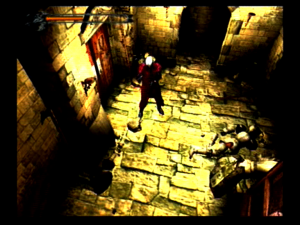 unethical scientific experiments. You assume the role of Dante, a demon hunter/investigator who uses his skills to exercise demons for profit and to avenge the loss of his family from said creatures. One night while working, Dante is hired by a mysterious woman named Trish, who after a brief but amazing test of Dante’s skill, hires him to go to an abandoned castle where Mundus, the demon who is responsible for the death of Dante’s family, is planning a return from hell. Unknown to our badass hero, he has taken on a a job that starts out as an opportunity for vengeance, but soon will unlock an ancient birthright and his true destiny as mankind’s newest protector against demonic forces.
 The graphics are beautiful as Capcom developed a great game engine and made great use of the PS2’s technological capabilities to bring out the action without using the god-awful camera angles found in Resident Evil. I personally liked how each cutscene brought DMC’s storyline together without any over-the-top drama. The enemy variety is good, too, ranging from demon marionettes to giant owls and other demonic creatures. I enjoyed the voice acting because it was not forced, flowing in sync with the game’s plot. I am proud to say that I would definitely replay this game when I’m feeling like I want to rip some demons apart.
 chose between using X and Zero, who each have unique abilities. I chose Zero because of the option to use his Z‑Saber and Z‑Buster as more effective combat tools, and also because of his stronger jumping abilities.
 relationship with them so that you are considered neighborly. The town’s set schedule makes for interesting interactions and a type of schedule planning not unlike Animal Crossing. While you’re working to save your farm and chatting up the townsfolk, you’re given a third task of finding a suitable lass in town to wife up. If you can manage to put a ring on it by wooing your intended (there are five lovely ladies that you can choose from to pursue with varying likes and dislikes), you’re all but guaranteed to earn your place in the town and be allowed to stay.
 on the playing field. There are so many factors that can affect your mice total at the end of a round that it’s impossible to win by talent at moving rodents alone. One must consider the fact that only three arrows can be placed by a character at any given time. With level layout also taken into consideration, the idea that you can be in the lead for five seconds and that be enough to win is a real possibility. Throw in the power-up aspect and constantly changing conditions of the match area and there is a real recipe here for disaster disguised as fun.
