
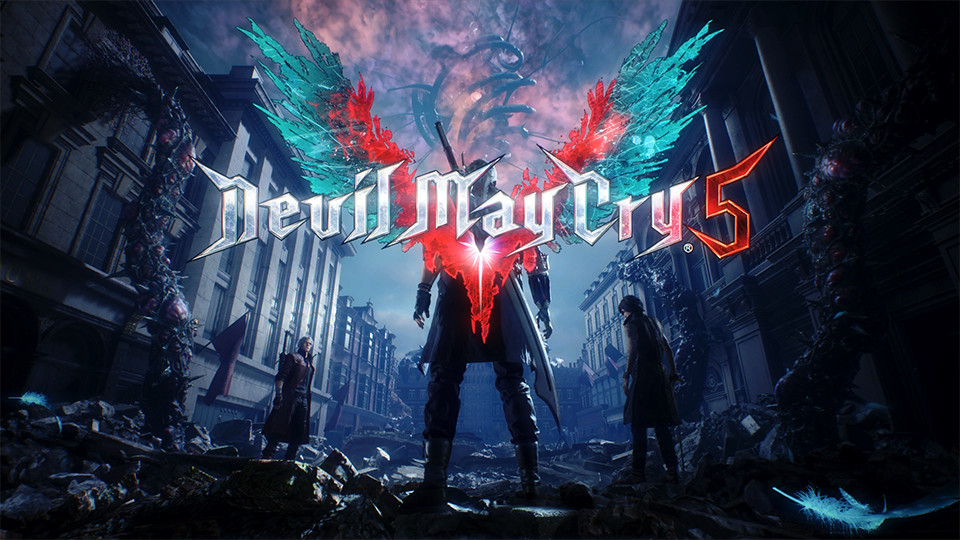
Fifth time’s a charm: DMC 5 hunts down payoff
“Devil may cry.” To some, it sounds like the latest quote from one of Hollywood’s biggest action stars. To me, it’s one of Capcom’s biggest franchises that does not involve “Street Fighter” and “Resident Evil” that is a labor of love to play. Nero and Dante are back along with some new faces to raise more demonic hell across next gen gaming consoles with the hack and slash style of gaming that put it on the map. I waited five years to play the fifth installment of this series and the kick-ass promotional song “Devil Trigger” helped move that wait right along. In April 2019, me and EIC Lyndsey were on a spur-of-the-moment gaming shopping spree and not only did we pick up a PlayStation 4 Pro, but also we picked up a bounty of games including DMC5. Could it surpass previous successes that defined the series?
In DMC5, years after the events in DMC4, Nero has gotten Dante’s blessing to jump in 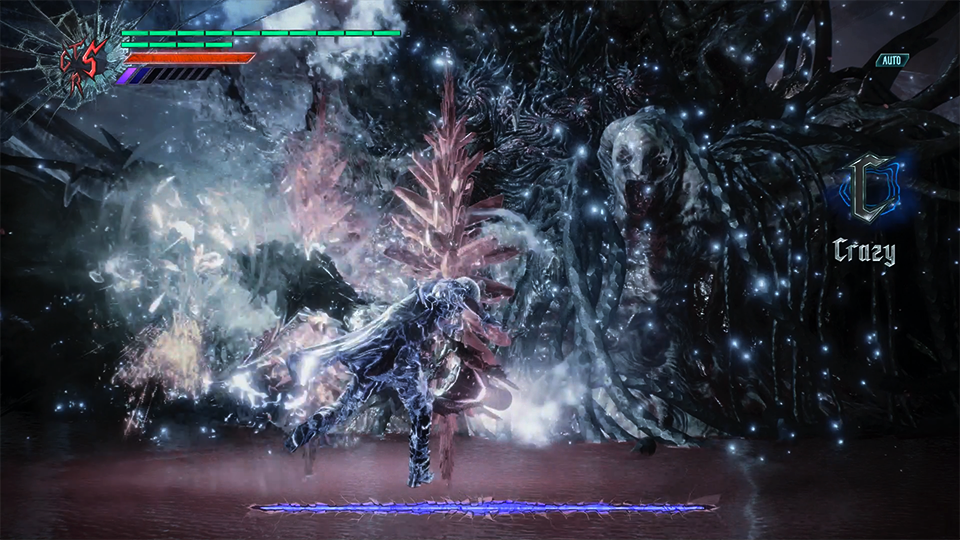 the demon-hunting business but one May night, Nero is accosted by a familiar foe who has not only taken the demon sword Yamato, but also Nero’s demonic arm. Vowing vengeance, Nero pursues the foe to Redwood City where he is introduced to a new evil known as Urizen. He, Dante and fellow demon hunters Trish and Lady are swatted instantly by Urizen. Now having a HUGE chip on his shoulder, Nero returns with a new arm and partner in crime, Nico, and sets out on his second adventure filled with old and new allies and enemies while making his name as a master demon hunter to surpass his infamous uncle.
 Gameplay in DMC5 follows the same high-speed action formula found in previous games in the series. Controlling Nero, Dante and the newest character V is perfect. Nero still has his trusty sword Red Queen and revolver Blue Rose, but instead of his Devil Bringer he uses a prosthetic arm called a Devil Breaker, which was developed by Nico. It has extra punch than the Devil Bringer and can be upgraded after battles with various bosses.
Dante has his dual pistols Ebony and Ivory as well as his usual swords Rebellion and Sparta, but also has five additions: Cavilare (a motorcycle that when separated, becomes a buzzsaw-like weapon); Balrog (yes, THAT Balrog), gauntlets and boots that increases Dante’s melee power tenfold; KalinaAnn2, a modified version of the KalinaAnn used in DMC3; and, Dr. Faust, a hat that shoots out red orbs when worn.
V has some tricks up his sleeve with his familiars Griffon, a demon hawk capable of firing lightning bolts and projectiles; Shadow, a panther-like familiar that is melee combat oriented, using its body to form blade and needle weapons; and, finally Nightmare, a golem-familiar that moves slowly, but packs a MAJOR punch against giant enemies. I should also note that Nightmare can change his height to titan-level and use a huge laser beam to destroy enemy bosses, which allows V to use his Royal Fork cane and its copies to land the finish blow.
Another feature I liked in DMC5 was the training session that allows you to learn and practice available skills before purchasing them, allowing you to decide whether to buy or hold off.
The RE5 engine brings every detail to life, complementing Dolby Atmos sound’s abilities, which made me think I was playing a 3D movie instead of a video game. The voice cast is a mix of well-known and new voice actors led by Reuben Langdon, Johnny Yong Bosch and Daniel Southworth reprising their roles as Dante, Nero and Vergil, respectively. Stephanie Sheh returns as Kyrie but in voice form only. I also give kudos to Brian Hanford for voicing V and Faye Kingslee as Nico. Brad Venable as Griffon stole the show, and Kate Higgins (Bleach, Code Geass) and Wendee Lee were excellent as Lady and Trish.
The only negative thing I have about the game is the camera control. It has improved GREATLY, but it still takes some time to masterfully plan a character’s next move. The power-up situation that occurred in DMC4 was fixed, but you still need to conserve your red orbs, especially if you use Dr. Faust.
DMC5 is worthy of replay because of its excellent blend of action, drama and environment. Capcom is doing this series right again and while I don’t agree that milking a franchise is the best business decision, DMC fans can begin to forgive Capcom for its lack of judgement for DMC: Devil May Cry. Let the healing begin.
Fun facts
- Reuben Langdon, Johnny Yong Bosch and Daniel Southworth have a connection to the Power Rangers franchise. Bosch was the second Black Ranger in Mighty Morphin’ Power Rangers and the Green Ranger in Power Rangers ZEO and Power Rangers Turbo, while Langdon did stunt work and Southworth played the Quantum Ranger in Power Rangers: Time Force. All have provided voice and motion capture work for the DMC series.
- Southworth and Wendee Lee had dual roles as Urizen and Eva, Dante’s and Vergil’s mother.
- If Redwood City looks like London, you are correct. Capcom sent the DMC5 development team to London — specifically Midhurst in West Sussex, Rochester, Kent, Canterbury and Leeds Castle in Kent — for inspiration in designing locations in the game. Various models and clothes were acquired and scanned in London and Serbia.
- In addition to the RE5 engine, Capcom used Microsoft’s Simplygon graphic software to assist with graphics and the intermission graphics.
- The most notable song of the game, “Devil Trigger,” by Casey and Ali Edwards, has had more than 2.8 million views on Capcom Japan’s YouTube channel. Ali Edwards was also the lyricist and vocalist for the game’s ending theme “Legacy,” with composition by Kota Suzuki.

 discovered the upgrade. The home port of Super Street Fighter
  Hyper Fighting, but it’s Street Fighter at peak Street Fighter. That also applies to the controls. It’s the Street Fighter that you know and love but cleaned up just a tad.
 What you need to take away from
 unknown terrorist groups using the top-secret helicopter known as Airwolf. As String conducts the mission, he finds out that one of the prisoners being held is his long-lost brother who was declared missing in action during the Vietnam War. This gives him added incentive to carry out his given mission.
 The graphics were
 Batman is easy to guide around, though there are a few spots where the directions and what to do could be a little more clearly pointed out. However, Batman is fluid and moves quickly enough that getting around Gotham to take on the Penguin and Catwoman isn’t much of a problem.
 Much like the graphics, the sound is also spot on and close to the movie’s backing tracks. Of course, there are a few appropriations because you’re not getting a full orchestra with composer Danny Elfman on the
 moving left and right with the control pad, jumping with a button, and attacking with basic weapons by using combinations for special weapons. These controls have special designations for Grant, controlling how high he can jump and climb walls, and for Alucard, who can transform into a bat. To give this team of vampire hunters an extra advantage, Trevor can upgrade his mystic whip to a long-ranged chain whip and can use various Warakiya items such as the banshee boomerang, battle ax and a pocket watch that temporarily freezes enemies. Sypha has her magic staff as her main weapon in addition to using elemental orbs that can produce fire, ice and thunder attacks. Grant has use of the dagger, but he can only use the mystic ax as his secondary weapon. Alucard has use of a destructive ball that can be upgraded to shoot three directions.
 finally blew up in the U.S., and we finally started receiving mixes much like Japan. The problem was, we were getting them years after the fact, and when we did get them, they were mostly lacking — broken, incomplete messes that you were better off pretending didn’t exist. That, my friends, is where we join our story already in progress with Dance Dance Revolution Extreme 2.
 2004, a full two years after the original was released in arcades and for PlayStation 2 in Japan. That game is absolute garbage: It’s nothing like what Japan received, which is a game that’s much closer to the arcade version of Extreme. We received a broken and changed-for-the-worse song interface, missing and weird songlist and grading mechanics that were excised as of
 unlock special characters, karts and gliders, usually in the high-end category, as well as level up your established roster. The gatcha pulls are obnoxious because it’s dependent on luck of the draw using real money to fund the pulls. The real money — that you’re pulling out of your wallet — is spent in the form of rubies, which allow you to pull from pipes possibly containing the high-end items in batches of one pull for five rubies or 10 pulls for 45 rubies. Though the rubies are moderately priced, it’s the fact that you must buy the rubies or complete sometimes ridiculous challenges to get rubies that makes it beyond the pale.
 In addition to the tool-like single-player mode, there is the multiplayer mode from hell. I wish I could somehow convey the trash-like qualities of multiplayer in words, but I’m at a loss without getting an