

Onimusha 2 has elements of satisfying sequel
Previously, I reviewed the first game in Capcom’s critically acclaimed series Onimusha,  where historic figures and moments in Japanese history were mixed with action/adventure gaming, third-person combat and brief moments of puzzle solving. After playing the first game, I wondered if the second installment would keep the successful formula and raise the bar for future installments. When I received Onimusha 2: Samurai Destiny, I put on my custom-made samurai armor and prepared to have my questions answered.
Onimusha 2 continues the plot of chosen warriors working to prevent Oda Nobunaga from unifying Japan through the use of demons called genma. Set 10 years after the first game, Nobunaga has risen to power despite the defeat of his demonic benefactor Fortinbras, who was stopped by original protagonist Samanouske Akechi. With Samanouske in hiding to perfect his new demon slaying abilities, it’s up to Jubei Yagu to take up the sword and acquire five legendary orbs and use them to stop Nobunaga before his dark plans of conquest becomes reality and demons become the dominant species of Earth instead of man.
Gameplay in Onimusha 2 remains the same but does have some new elements. During combat with enemies, you can still fight through enemies, but if timed correctly, Jubei can perform “Issen” (lighting slash) on various enemies, allowing him to continue forward, giving him a brief minute to defend himself or retreat. Another element is the requirement to solve certain puzzles to obtain certain items or gain access to certain areas. For these puzzles, I highly advise utilizing patience and strong memorization as they have a much stronger effect in Onimusha 2 than in the first game. The final new element is role playing that enhances the storyline. Jubei can not only interact with non-playable characters, but also gain allies who will give information or assist him in boss battles provided he is in constant contact with them or if his allies are not involved in their own plans to defeat Nobunaga.
 In addition to new allies, you will notice that Jubei is normally equipped with his sword, but can acquire weapons such as bows and arrows, a matchlock gun and other weapons that use the power of natural elements. Jubei does have two other advantages to help as well: The ability to temporarily transform into Onimusha with enhanced attack power; and, the power to acquire various souls without the use of a ogre gauntlet to upgrade his armor and weapons.
The controls will not present any level of difficulty especially if the Dual Shock analog controller is used. You can appreciate the quality of the characters’ movements in gameplay and in the cut-scenes which may make one wonder if they are playing a samurai adventure game or watching a movie.
The music performed in this game is excellent as Capcom’s sound team always brings their best efforts, guaranteeing that the music will be a treat. If you enjoy instrumental Japanese themes, you’ll probably love the soundtrack.
Onimusha 2: Samurai’s Destiny did exceeded my expectations for a game to be considered a true samurai masterpiece. This not only shows that Capcom can unleash their brilliance if they really try, but also shows other developers that in order to bring a superb gaming product involving various elements of Japanese culture, they must willfully present historical elements properly while crafting a high quality storyline. I can not wait to start the next chapter of the Onimusha series where the next destined hero strikes another blow to Nobunaga’s ambitions.

 genre: competition. There have been fabled rivals throughout the entire lifespan of the genre, with quite a few pretenders to throne. However,
  times and keep eyes on the product. At its core, it’s a game about samurai and other warriors fighting to the death. What sets it apart from the competition — even from within its own stable with brethren King of Fighters — is its production values. The games have always been gorgeous and there’s a level of detail that hasn’t been seen in other series except for the likes of Tekken. Within the collection of that is Anthology, all of the naturally gorgeous artwork and level of detail is on display. It’s important that this be emphasized because that’s what Samurai Shodown is about at the end of the day: Samurai fighting to the death while looking fantastic.
 soundtrack is an excellent concerto of Japanese bamboo flute and shamisen. This may not float your boat, but for a package that focuses on samurai, this is an excellent choice to make up the backing soundtrack.
 with, the music, characters and graphics are top-notch and the story is simple. My only complaint is that there’s one cheap-shot character that loves to pounce. For all of the SoulCalibur clones flooding the market these days, I proudly say Samurai Shodown Anthology has great replay value, and it
 It’s simplified even more thanks to the Wii’s Classic controller, GameCube controller, third-party arcade sticks and the regular Wii remote. You will love the character roster consisting of each companies’ top franchises such as Street Fighter, Rival Schools, Viewtiful Joe, Lost Planet, Darkstalkers/Vampire and Mega Man for Capcom while Tatsunoko is represented by Karas, Tekkaman, G‑Force and Yatterman. There are other characters that can be unlocked via use of money (Zenny) earned in each game, which also will allow purchase of alternate endings, costume changes and other unlockable surprises.
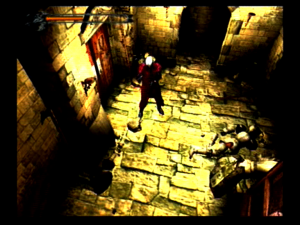 unethical scientific experiments. You assume the role of Dante, a demon hunter/investigator who uses his skills to exercise demons for profit and to avenge the loss of his family from said creatures. One night while working, Dante is hired by a mysterious woman named Trish, who after a brief but amazing test of Dante’s skill, hires him to go to an abandoned castle where Mundus, the demon who is responsible for the death of Dante’s family, is planning a return from hell. Unknown to our badass hero, he has taken on a a job that starts out as an opportunity for vengeance, but soon will unlock an ancient birthright and his true destiny as mankind’s newest protector against demonic forces.
 The graphics are beautiful as Capcom developed a great game engine and made great use of the PS2’s technological capabilities to bring out the action without using the god-awful camera angles found in Resident Evil. I personally liked how each cutscene brought DMC’s storyline together without any over-the-top drama. The enemy variety is good, too, ranging from demon marionettes to giant owls and other demonic creatures. I enjoyed the voice acting because it was not forced, flowing in sync with the game’s plot. I am proud to say that I would definitely replay this game when I’m feeling like I want to rip some demons apart.
 chose between using X and Zero, who each have unique abilities. I chose Zero because of the option to use his Z‑Saber and Z‑Buster as more effective combat tools, and also because of his stronger jumping abilities.
  armor from