

A serviceable tale on paper
The moment you know Mario has gone on too many adventures is when you know you’ve played way too much Mario. Paper Mario, the sequel to the hard-to-top Super Mario RPG, is when I knew I’d played way too much Mario and seemed to expect way too much from a Mario game. The joke, however, was on me as I realized that an in-depth and long adventure awaited, and a story was to be told here that needed to be told after the highlight of RPG.
Paper Mario starts out much like any other Mario game: The princess has been kidnapped and Mario needs to save her. However, there’s a twist in the danse macabre that is Mario and Bowser’s eternal struggle over Peach. Bowser has managed to get his hands on the Star Rod, imprisons most of the wish-granting community and has literally absconded with Peach and her court into the sky. This is the point at which you should be saying, “Really Bowser? You just helped save your universe in RPG and you’re back to creating problems again?” But, nevertheless, the story must go on and Paper 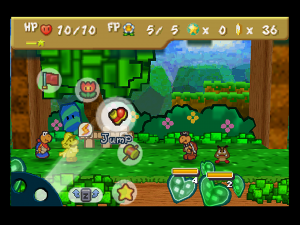 Mario fills that void nicely with an engaging tale of teamwork and camaraderie. I was most impressed with the depth of the characters and the deft way Intelligent Systems fleshed out the world of Mario and some of his never-before-seen allies who come from all walks of the Mario life.
Another impressive part of the tale is the tongue-in-cheek humor sprinkled liberally throughout. Paper Mario isn’t afraid to be self-referential or pinch off other games when it calls for shaking up the routine “Mario saves Peach” bit.
Spoilers ahead: There is a section that calls for a certain princess to become a virtual Solid Snake-like character and it immediately calls forth images of Metal Gear Solid.  That kind of borrowing is the kind of thing that’s allowed and plays well within the context that Mario is the king of all that he surveys and even in his spinoff titles, he can still run with the best of the best, pay homage and still come out smelling like roses.
In his second RPG outing, Mario still plays just as well as his first attempt in the role-playing sphere. Paper looks like and plays out like a storybook, which is fresh and inviting to old diehards like myself. The mechanics are simple to learn and are layered enough that an experienced RPGer can jump right in and understand what’s going on without much explanation.
If you played the first game, concepts such as timed defense, timed offense and first hits will make sense. It’s that kind of referencing that makes the game a success: It’s easy to pick up and play, regardless of your level of familiarity with the series’ system.
My main gripe, though, is that the game feels sprawling and slightly disjointed at times. That’s a great problem to have actually, but there are times when backtracking and the seemingly endless sidequests tend to distract from the main goal. Still, I’d rather have that problem than be bored with nothing to support the main story.
Also, as a rather nitpicky side gripe, the final boss fight is one of the most aggravating fights I have ever experienced.
I was easily in that battle for half an hour solely because of the boss’ ability to heal, not because I was doing anything particularly wrong. If, at the end of the battle, I say, “I will never fight this end battle again,” there is a problem there.
It was as if it was protracted and drawn out for the sake of being a hard boss battle.
My issues aside, though, I had an engaging and memorable time playing through and I couldn’t wait to work through a new chapter in the saga that was Paper Mario. This is a tale you literally can’t put down.

 elements from the original platforming masterpieces Super Mario Bros. and Super Mario Bros. 3. Joining those are secondary greatest hit Super Mario World and the more recent hit New Super Mario Bros. U. All four games represent some crowning achievement for the everyday plumber and thus have some merit for making you revisit these set pieces to create your own masterpiece.
 nitial two and ultimately the majority of your creation library are unlocked via a time system that goes by days. You can speed it up, but it’s intended to make you the creator spend several days trying out the system and getting a feel for new elements in a paced environment. I can appreciate the sense of not wanting too many elements all at once, but the system is a little slow and frustrating when I have a million ideas that I can’t fully implement for several days initially.
 it meant to duel an older sibling who had far better hand-and-eye coordination and reflexes and why teenagers seem to do much better at games than little kids.
 many years to get the hang of certain events. This is mostly because there wasn’t a lot of info out there in the days before the Internet and because, again, I had terrible untrained coordination and reflexes. Even today, with a wealth of tips out there, it’s still hard to get a bull’s‑eye in the archery, and it’s been nearly 30 years. Graphically, there’s a few things to look at, especially for an
  The music, while not especially memorable, is still serviceable. It’s not something you’re going to be humming well after you’ve put down that turbo controller, but it’s not bad, either. A lot of the tracks are well done and fit the general mood of the event you’re participating in. There are a lot of sound effects in the game and they are generally what make the game what it is.
 hell and high water. But wait, this time it’s different! No, you aren’t saving Pauline this time around; no, you’re Donkey Kong Jr., the scion of Kongdom saving your incorrigible father from the clutches of evil human Mario. The fact that another ape has to save his parental figure from Mario in a complete role reversal begs several questions: Where was Junior when his father was kidnapping innocent maidens and running rampant? Why would Mario even bother to kidnap the great ape in the first place? Sure, there’s the motive of revenge, but you’re never going to get your question answered, try as you might. You just have to accept that
  Instead, you’ll watch Junior repeatedly get eaten alive by crocodiles (we’re not sure why a plumber would employ these dangerous live creatures to kill an ape), nailed by random falling objects and fall to his obvious and horrific death, all because he’s underdeveloped at jumping and climbing.
 While the challenges may be different, there isn’t much else different about the games. The music and graphics from the 8‑bit era remain intact and about the only thing that’s changed is the slick modern packaging of the Ultimate Remix itself and the addition of leaderboards and championship mode. So, don’t come into this expecting depth or some magical upgrade to modern day standards of graphics.
 repertoire of the Prince, such as the Prince Hop and the King Shock, but otherwise you’re still rolling along to pick up items to make your katamari grow. The series isn’t known for its growth and this is a major reason why. While it’s easy to control the Prince and maneuver the Katamari, there still should be some innovation at this point, five games in.
 much like playing any platformer of the past 20 years and the control scheme is simple and intuitive in letting you figure out what to do and how to apply it later. Where it falters is the jumping mechanics. While obvious and simple, the jumping does feel slightly off and floaty, which is a problem in a game that relies on that mechanic to carry it. It’s annoying to have to re-do sections of a level solely because of a missed jump, and that detracts from the core experience.
 of the board game mode and the character creation mode that plays out like an eroge simulation are some of the goodies that we’re missing out on in the U.S. There’s also the addition of three new characters: Ran, a photojournalist who uses her camera to attack; Nagare, a swimmer; and, Chairperson/Iinciyo, who leads the charge for Taiyo High School students to defend themselves. Other than these gifts, there’s not much different here than the first game. You’re still fighting to defend your chosen school, and there’s still fun to be had in a slightly deep fighting game system. There’s not too much different aesthetics-wise, in that there are a few new stages and new stage themes. The older stages are still here and it’s fun to play against the newcomers with older characters or a created character.
 I have two caveats with recommending the game to others. The first is the fact that it’s in Japanese mostly and reading is a must to get through the character creation and board game modes. That’s a bit much if you’re not into the language or know enough to navigate through menus. The other issue is the fact that, as usual, Capcom has seen fit to deny American gamers the best of a series,
  shortchanging loyal money-spending fans who would pay a high price for the goodies of the character creation mode and the board game mode. The dirty truth of it all is Capcom has never thought highly of its American audience. We’re not going to see something awesome like either mode because “we just wouldn’t get it anyway.” A fun fact is that both modes were to be included in the first game but were left out in America because it would have been too much trouble to include them for Americans, according to Capcom of Japan. But we’re smart enough to make cash grabs off of for multiple version of Street Fighter, though, right?
 tend to ignore the meter altogether. Also, the foot rating is missing and song difficulty rating numbers have yet to come (that’s not until Max 2). But the song wheel has been freshened up so it looks a lot better and is a little more palatable.
 away songs like Share My Love and Dive, but overall it’s quite a few excellent choices thrown together to make a good song list. The variety is nice and it feels like a good fresh start for a series that had a lot of repeats in the first five games.
 times and keep eyes on the product. At its core, it’s a game about samurai and other warriors fighting to the death. What sets it apart from the competition — even from within its own stable with brethren King of Fighters — is its production values. The games have always been gorgeous and there’s a level of detail that hasn’t been seen in other series except for the likes of Tekken. Within the collection of that is Anthology, all of the naturally gorgeous artwork and level of detail is on display. It’s important that this be emphasized because that’s what Samurai Shodown is about at the end of the day: Samurai fighting to the death while looking fantastic.
 soundtrack is an excellent concerto of Japanese bamboo flute and shamisen. This may not float your boat, but for a package that focuses on samurai, this is an excellent choice to make up the backing soundtrack.
 PlayStation 2. For decades,
  with, the music, characters and graphics are top-notch and the story is simple. My only complaint is that there’s one cheap-shot character that loves to pounce. For all of the SoulCalibur clones flooding the market these days, I proudly say Samurai Shodown Anthology has great replay value, and it