
Marvel Origins did series proud with two best games

Editor’s note: This review originally appeared in Issue 21 (1Q2013). It has been edited for spelling, grammar and clarity.
There are those of us who love games and comic books, and then there’s those of us who love the Versus fighting game series. I’m firmly in the camp that loves the Versus series with passion. Some games more than others attack my heart, but I really appreciate the depth and intricacy that can be found in Marvel characters teaming up to fight alongside or against each other or Capcom characters. Out of all the series’ offerings, I seem to derive the most pleasure from Marvel vs. Capcom.
Of the various versions of the game out on the market, this newest version belongs in the premier echelon of treatment. It’s packaged with Marvel Super Heroes ― the second game in the series ― and gives some of the newer gamers the background necessary to fully understand what’s being dangled in front of them today with Ultimate Marvel vs. Capcom 3. True, there isn’t an excess of 56 characters or the gaudiness of X‑Factor as a draw, but the foundation and the buildup on that foundation are present through both games and that’s what matters when you want to learn where a franchise comes from.
If you’re a purist in terms of the structure of the game, this is a version that deserves a purist’s critical eye. The gameplay in both games is perfect. It’s as smooth an experience as putting in quarters at an arcade and playing to your heart’s content. Moves work the way they should, and combos can be pulled off very well. Gameplay quirks ― such as Marvel vs. Capcom’s frustrating difficulty in the arcade mode ― are still there, but that shouldn’t be a deterrent to the overall experience. And for me, it wasn’t. I picked it up and played Marvel vs. Capcom immediately as if it were the Dreamcast version, which is also an arcade-perfect port. Marvel Super Heroes is a sublime play experience as well for many of the same reasons.
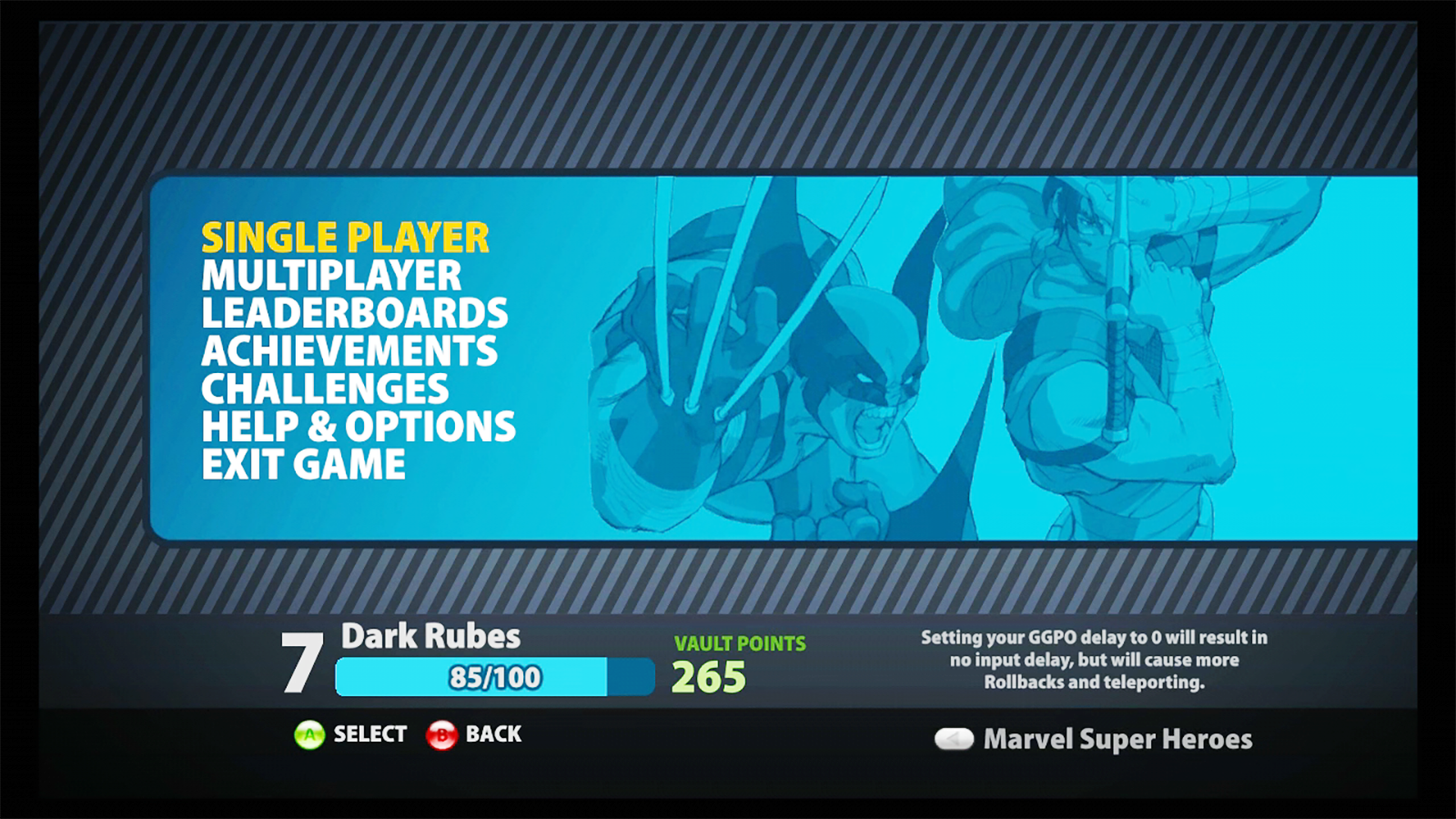
Because these are arcade-perfect renditions of the games, the music and graphics are pretty much the same, too. There are a few options added for the view, and I must applaud the creation of the challenge sidebar that can be turned on or off for both games. It’s a neat way to keep abreast of progress in the games’ accomplishments, and the view doesn’t get in the way of the gameplay. Done in an arcade cabinet style, it’s easier to keep up with the action than if the game were in wide-screen format.
 If you consider yourself a fighting game effector and you loved the Versus series, you’re probably going to love this. It’s especially poignant to be able to play the early entries in the series now that consoles and fighting games have moved on from this style of play. It’s easy to forget about the progenitors of a series when there’s fresh blood in town. Marvel vs. Capcom Origins somehow manages to bring back familiar gameplay while retelling its origin story to a newer generation.