

Like father, like son
I don’t believe there is anyone who reads GI who doesn’t know that I don’t care for Donkey Kong. By now, it should be painfully obvious that I don’t care for the simian’s retro exploits or his more recent outings, either. It’s not that I don’t respect what the great ape has done for gaming; it’s more that I feel he gets credit for mediocre-to-horrible games. Donkey Kong Jr. falls on the lower end of the spectrum.
Much the same tripe as the original, you’re tasked with saving someone by moving across  hell and high water. But wait, this time it’s different! No, you aren’t saving Pauline this time around; no, you’re Donkey Kong Jr., the scion of Kongdom saving your incorrigible father from the clutches of evil human Mario. The fact that another ape has to save his parental figure from Mario in a complete role reversal begs several questions: Where was Junior when his father was kidnapping innocent maidens and running rampant? Why would Mario even bother to kidnap the great ape in the first place? Sure, there’s the motive of revenge, but you’re never going to get your question answered, try as you might. You just have to accept that DK needs saving and it’s up to you, his reliable offspring, to do the job.
Hoping that your adventure in saving your father is worth it, the game tasks you in utilizing a jumping and climbing mechanic that may or may not work, depending on where you are height wise. Any fall more than a few pixels high will kill you, which makes about as much sense as the kidnapping caper you seem to be embroiled in. Whoever had the bright idea to make jumping a chore and maneuvering your ape around impossible obviously didn’t get that this was a bad design decision immediately. Seeing as though they are the only skills your ape has, it would have been a little bit wiser to make those work well.
 Instead, you’ll watch Junior repeatedly get eaten alive by crocodiles (we’re not sure why a plumber would employ these dangerous live creatures to kill an ape), nailed by random falling objects and fall to his obvious and horrific death, all because he’s underdeveloped at jumping and climbing.
And while you’re witnessing this obvious act of poaching, it’d be wise to use some headphones. The music, much like the original game, isn’t the greatest and it will get monotonous immediately. Donkey Kong Country this isn’t.
Your best bet is to try the game just for the nostalgic factor in seeing a pretty rare character; Junior was last seen, by my count, in Super Mario Kart for the SNES. He isn’t putting in too many other appearances and maybe, just maybe, it was this trip out of the jungle that convinced him to let his father do all of the adventuring in the family. This barrel isn’t full of laughs or a blast.

 of the board game mode and the character creation mode that plays out like an eroge simulation are some of the goodies that we’re missing out on in the U.S. There’s also the addition of three new characters: Ran, a photojournalist who uses her camera to attack; Nagare, a swimmer; and, Chairperson/Iinciyo, who leads the charge for Taiyo High School students to defend themselves. Other than these gifts, there’s not much different here than the first game. You’re still fighting to defend your chosen school, and there’s still fun to be had in a slightly deep fighting game system. There’s not too much different aesthetics-wise, in that there are a few new stages and new stage themes. The older stages are still here and it’s fun to play against the newcomers with older characters or a created character.
 I have two caveats with recommending the game to others. The first is the fact that it’s in Japanese mostly and reading is a must to get through the character creation and board game modes. That’s a bit much if you’re not into the language or know enough to navigate through menus. The other issue is the fact that, as usual, Capcom has seen fit to deny American gamers the best of a series,
  shortchanging loyal money-spending fans who would pay a high price for the goodies of the character creation mode and the board game mode. The dirty truth of it all is Capcom has never thought highly of its American audience. We’re not going to see something awesome like either mode because “we just wouldn’t get it anyway.” A fun fact is that both modes were to be included in the first game but were left out in America because it would have been too much trouble to include them for Americans, according to Capcom of Japan. But we’re smart enough to make cash grabs off of for multiple version of Street Fighter, though, right?
 Graphically, Max represents the beginning of a new era. Sure, it resembles current
  tend to ignore the meter altogether. Also, the foot rating is missing and song difficulty rating numbers have yet to come (that’s not until Max 2). But the song wheel has been freshened up so it looks a lot better and is a little more palatable.
 away songs like Share My Love and Dive, but overall it’s quite a few excellent choices thrown together to make a good song list. The variety is nice and it feels like a good fresh start for a series that had a lot of repeats in the first five games.
 modern gaming society have been resurrected, and I’m not exactly sure for whose benefit. Hard Drivin’, mentioned and dissected in GI’s horrible games podcast of yesteryear, is the worst offender of the bunch. I have no earthly idea who thought this was an arcade classic and why it needed to be thrust upon the masses again. It was a horrible game to begin with and deserves no further discussion or inclusion to reanimate it from the depths of hell where it belongs (Editor’s Note: Fun factoid — Hard Drivin’ provided the basis for GI’s Torture of the Quarter column). N.A.R.C. also warrants a mention as a title to avoid, as well as Primal Rage. Let’s face it, Primal Rage was touted as competition for the likes of Mortal Kombat, Street Fighter and Killer Instinct back in the day, but no one with any sense ever took it seriously. The game doesn’t inspire any new feelings of doing so after 20 years.
 What is welcome, however, is the inclusion of the behind-the-scenes material. Documentaries and making-of materials are included as bonus features for a few games, most notably Mortal Kombat
 May Cry. Ever since DMC’s arrival in 2001, it has grown from a critically acclaimed series to written and visual adaptations in comics, written novels and other various merchandise. Originally set in the Resident Evil universe, because of technology restraints and an expanding reverse storyline from Resident Evil, the series was ported to the PlayStation 2. Having enjoyed experiencing the manga’s action, I wondered if I would feel the same when I played the first
 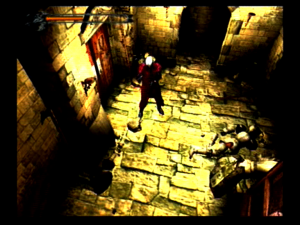 unethical scientific experiments. You assume the role of Dante, a demon hunter/investigator who uses his skills to exercise demons for profit and to avenge the loss of his family from said creatures. One night while working, Dante is hired by a mysterious woman named Trish, who after a brief but amazing test of Dante’s skill, hires him to go to an abandoned castle where Mundus, the demon who is responsible for the death of Dante’s family, is planning a return from hell. Unknown to our badass hero, he has taken on a a job that starts out as an opportunity for vengeance, but soon will unlock an ancient birthright and his true destiny as mankind’s newest protector against demonic forces.
 The graphics are beautiful as Capcom developed a great game engine and made great use of the PS2’s technological capabilities to bring out the action without using the god-awful camera angles found in Resident Evil. I personally liked how each cutscene brought DMC’s storyline together without any over-the-top drama. The enemy variety is good, too, ranging from demon marionettes to giant owls and other demonic creatures. I enjoyed the voice acting because it was not forced, flowing in sync with the game’s plot. I am proud to say that I would definitely replay this game when I’m feeling like I want to rip some demons apart.
 chose between using X and Zero, who each have unique abilities. I chose Zero because of the option to use his Z‑Saber and Z‑Buster as more effective combat tools, and also because of his stronger jumping abilities.
 relationship with them so that you are considered neighborly. The town’s set schedule makes for interesting interactions and a type of schedule planning not unlike Animal Crossing. While you’re working to save your farm and chatting up the townsfolk, you’re given a third task of finding a suitable lass in town to wife up. If you can manage to put a ring on it by wooing your intended (there are five lovely ladies that you can choose from to pursue with varying likes and dislikes), you’re all but guaranteed to earn your place in the town and be allowed to stay.
 on the playing field. There are so many factors that can affect your mice total at the end of a round that it’s impossible to win by talent at moving rodents alone. One must consider the fact that only three arrows can be placed by a character at any given time. With level layout also taken into consideration, the idea that you can be in the lead for five seconds and that be enough to win is a real possibility. Throw in the power-up aspect and constantly changing conditions of the match area and there is a real recipe here for disaster disguised as fun.


 immediately sets the game apart from its competition of the time. The game flat-out looks great on the GameCube, and the other console versions looked great, too. The GameCube version has an interesting control scheme that lends itself to rolling down the slopes, and it’s intuitive and becomes second nature as you become more comfortable pulling off various tricks. For that increasing level of comfort, you are rewarded with bigger and better items that should help you improve as well as make you look a little better on the track. It’s that drive to unlock these goodies and tracks that keeps you coming back to Tricky.
 atmosphere