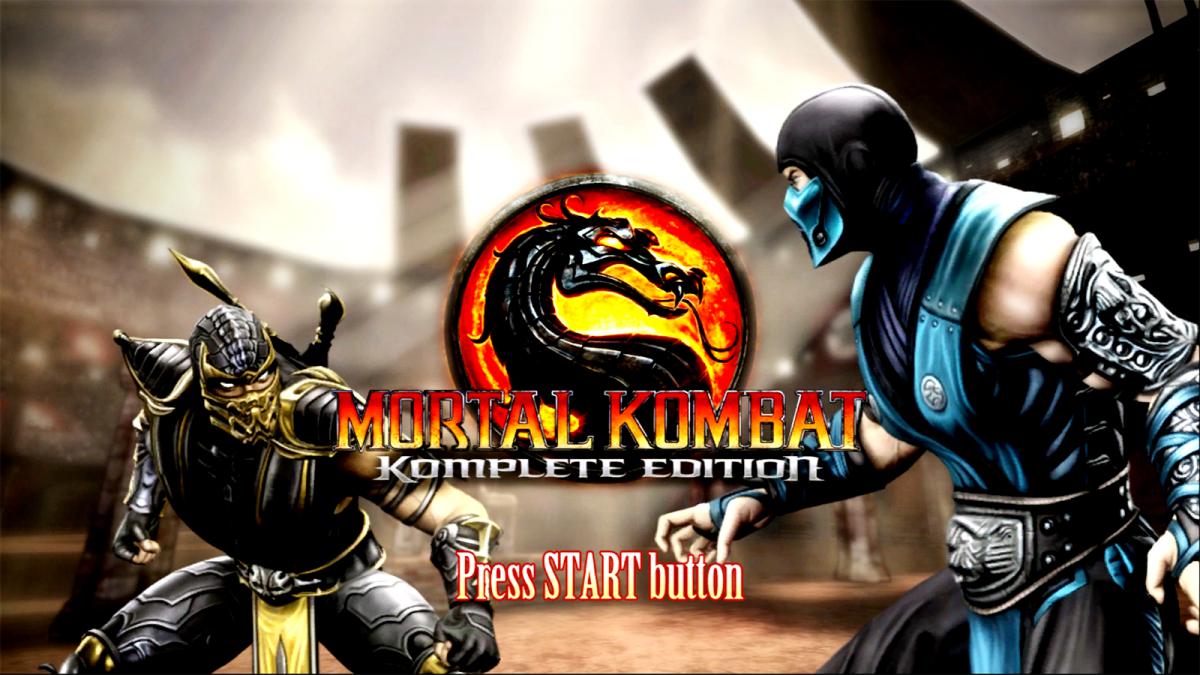
The former king of gore returns to reclaim its throne with a reboot
Editor’s note: This review originally appeared in 4Q2011. It has been edited for spelling, grammar and clarity.
 At the height of its popularity, the Mortal Kombat series managed to pack arcades across the country, spawn media properties and boost sales of just about anything it touched. Five disappointing games and the fall of arcades didn’t help the franchise, so it was naturally time for a reboot. This newest title manages to take Mortal Kombat back to its roots, update the gameplay and make MK relevant to the conversation about fighting games once again. At its core, MK has always been about fighting to the death. Forget the silly Puzzle Fighter knockoff, the semi-decent chess mini-game or create-a-fatality mechanic.
This is a series that prided itself on inflicting punishment and killing an opponent outright with vicious movesets and combo potential. The reboot manages to bring these features back to the forefront of a polished engine with appeal to the competing Street Fighter and Tekken crowds. It plays like a mix of those games with a dash of old-school kombat thrown in to make you realize that this is a refresher. The overall game speed is faster than previous entries, but it’s still easy enough that if you haven’t picked up a Mortal Kombat game since three you can still plow through some of the fights with no problem.
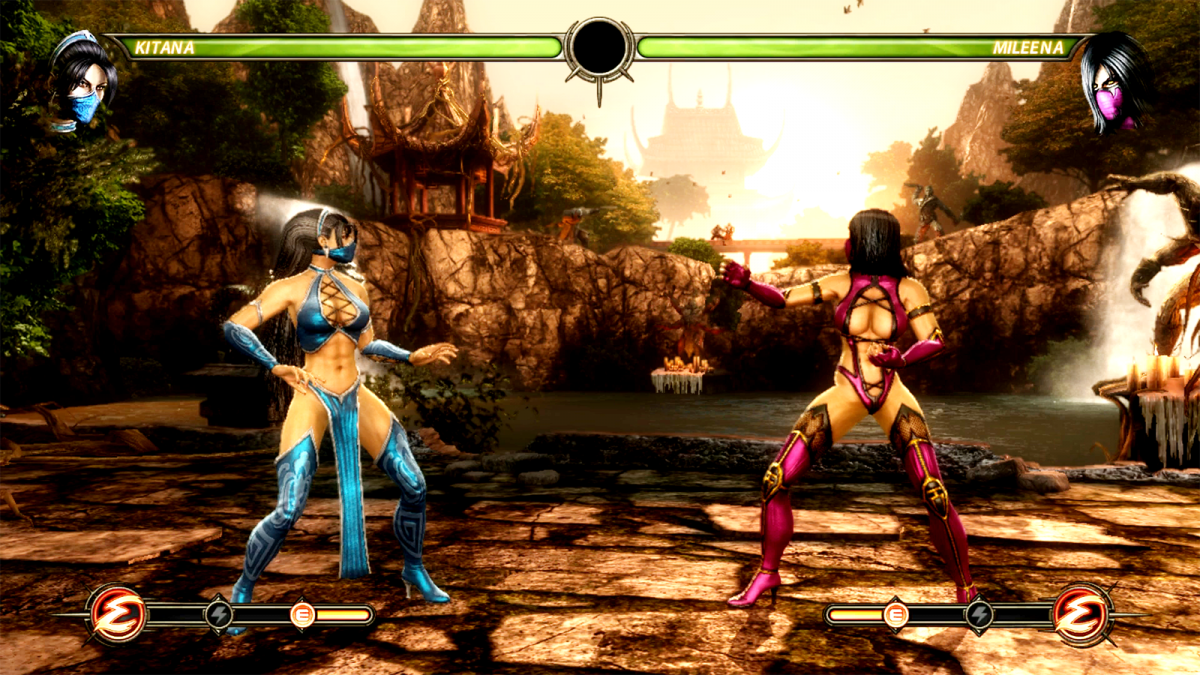
Just beware that the same statement also holds true when talking about the AI. In later fights, it’s still as annoying as ever and will outright cheat to win. That’s something that hasn’t changed since the original trilogy though it should have.
So, how does Mortal Kombat manage to refresh its past and become relevant again? By telling the same story in different ways in key spots. Playing through the story mode, I was pleasantly surprised at the way writer John Vogel, an original member of the MK team, cleaned up the lore. Some of the squeakier parts have been addressed, and I’ve had just about all of my questions dating back to the first game answered. Also, the story goes into much more detail about background events and even changes some of the more ridiculous events to have them actually make sense. Established canon may or may not make it through this, so don’t hold onto whatever you think you know about the Mortal Kombat storyline because it may not happen in this retelling. Where the story goes from here has unlimited potential, and it’s good to see that care will be taken in obvious future titles.
This is still Mortal Kombat that we’re talking about, so I’d be remiss if I didn’t compare it to previous games in the series. Though I’d like to forget that the series went past MK3, the graphics clean up nicely compared with Deadly Alliance, Deception and MK vs. DC Universe. The presentation has a weird glow about it, much like the one found in Tekken 6, but it actually helps the atmosphere of the game. Characters look real and animate fluidly. Also, the new idea of actually showing damage to characters is awesome. It’s nice to finally see a rumor from way back actually come true.
Soundtrack-wise, it’s a nice approach. The sound team has obviously increased since the MK team’s days at Midway, and it shows through the varied sound selections. Mortal Kombat still sounds like an old-school martial arts flick and that’s the way it’s supposed to be. The original versions of most of the older themes are also included as alternate selections, which is a great way to show off the older music, updated slightly, and remind new players that there was a series beforehand.
Despite being a fan of the reboot, there are some minor problems that I have with the game overall. It takes a little getting used to the way moves work now. Because I haven’t played much of the series since MK3, and I’m not a Tekken/Virtua Fighter player, the controls seem a little strange to me. It’s still Mortal Kombat-like but I’m not used to having that many moves at hand. It seems a little bit too much to digest at times, but that’s a fault of mine and not necessarily the game.
Also, the netcode left a lot to be desired when I tested it. However, it has been improved in the time since its release, making it easier to find matches and actually play online. That complaint, something that’s central to the game, has been worked on and continually improved, according to series co-creator and executive producer Ed Boon.
Finally, I’d like to throw out there that I’m not a fan of the Challenge Tower or the Krypt feature. The Kyrpt has been a part of Mortal Kombat for some time as a way to manage all of the unlockables within the game, but it’s cumbersome to find the appropriate item among the many numbered items. On a personal note, having a random Tarkatan creature jump up and scare the hell out of me is not fun in any way, shape or form when I’m trying to find a background song.
The Challenge Tower, on the other hand, gets boring fast. I do not want to have to go through 300 matches just to unlock a random thing and get an achievement. It was at match No. 135 I lost interest and moved on. I know that I can purchase skips, but that didn’t make that any easier or fun.
For every one thing that I dislike about the reboot, however, I can find something to take its place that I do love. I love the fact that Mortal Kombat is trying again to be relevant. I love that it takes itself seriously again and it’s trying to reclaim its former glory. I also love the fact that it recognizes that it isn’t Tekken or Virtua Fighter or even Soulcalibur, but that it has its own identity, one that deserves a refresher and restored honor.
Everything that made me fall in love with Mortal Kombat in its infancy is here and pushed forward again, updated and retrofitted with a renewed sense of pride. It’s kombat time again.
Score: 5 out 5
Gaming Insurrection has a long history with the Mortal Kombat series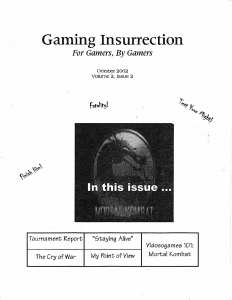
Mortal Kombat and Gaming Insurrection go way back. So far back, it seems, that Mortal Kombat was technically the spawn point for GI’s formation.
Once upon a time, in an arcade that doesn’t exist anymore, I got the idea to start writing about video games. It was 1993 and my love for Mortal Kombat II was in its infancy. I spent all of my waking time either thinking about or playing Mortal Kombat II, reading about it and going to middle school. I was an ambitious writer, charming folks through my prose and prattle about video games in general, mostly thinking I could do one better than the pros at GamePro. What better way to accomplish the dream of interviewing series co-creators John Tobias and Ed Boon than to get a job at GamePro? Because from my vantage point, if you can’t beat ’em, join ’em.
Well, I had no idea how to do something like that at 12 years old. Sure, I could write well, but I was still a long  way from getting out into the workforce. So, in steps the late GI Mama. My beloved mama listened intently when I said I had a dream of meeting and interviewing Tobias and Boon and offered the most endearing solution: Why not start your own magazine? She laid it out thusly: “Go to college and get a journalism degree so that you have the credentials you’ll need and set up your own thing so you can talk to them directly when you’re ready.” Ingenious, really.
So, that’s what I did. With her support, I set up Gaming Insurrection with co-founder Marcus Barnes on Jan. 1, 2002, in my kitchen. I was a sophomore at the University of South Carolina’s School of Journalism and Mass Communications when I began jotting down ideas for our first issue. I secured distribution through local import 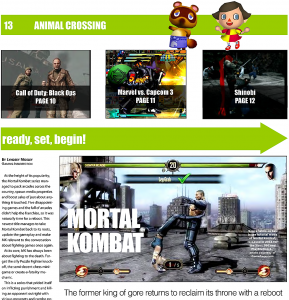 gaming shop Software Seconds and completed our first issue in August of that year. It has since been lost to time but the second and third issues are available on our website in the archives.
I never did achieve the main dream but my love for writing about Mortal Kombat hasn’t died down. I earned my journalism degree in 2003 and re-launched GI in 2008 with a continued focus on talking about my experiences and life with video games. GI has always focused on Mortal Kombat heavily as a result: Issue No. 3 is dedicated to MK as are several issues – we ran an MKII tournament throughout 2011 and 2012. We’ve done several podcasts dedicated to the franchise as well as reviews of multiple games in the series.
And while MK has run into some rough patches over the years, we’ve never stopped talking about the ingenuity and creativity that goes into making one of the best fighting game series out there. With Gaming Insurrection’s history deeply entwined with Mortal Kombat’s history, expect to see more MK in the future. Outstanding.
Lyndsey Beatty is editor-in-chief of Gaming Insurrection. She can be reached by email at lyndseyb@gaminginsurrection.com