X marks the spot for Mortal Kombat’s 10th game
 I promise y’all that I never thought I’d see the day when I would say something positive about a return to Mortal Kombat 4, but here we are. Sure, Mortal Kombat X is a return to the dark days of kombat, but it does prove you can sometimes go home again without beating a perennial fallen Elder God’s tale to death.
MKX starts off with a bang and 25-year time jump between the current story and the previous game. Those that died in the fight against Shao Kahn are now minions of Shinnok. Speaking of the Netherrealm emperor, he’s trying to be released into the world again to wreak havoc once more. It was revealed in MK9 that he set the plan in motion by manipulating Shao Kahn through main lackey Quan Chi, and he’s poised to achieve his goals with the reclamation of his Amulet. While all of this is happening, series newcomer Kotal Kahn and series stalwart Mileena are fighting a civil war for the right to rule Outworld. The plot is great and definitely adds a little pizazz to the lore of what is a long series.
While it’s not fun to see many of my old favorites dead, I can stomach it for the sake of moving the story forward. New additions to the cast, such as Erron Black and D’Vorah, make sense even though it’s addition in the vein of “they were there all along, but you didn’t see them until now.” The older returning faces, such as Kenshi and Johnny Cage, are nice to see, though we’re not jazzed by so much of the focus and plot armor on Cage and his ilk. But it’s rectified in later entries, so we’ll let it slide here.
And with a virtually new cast, we can kind of let it slide that the story is basically Mortal Kombat 4 retread with a twist! Because we have the benefit of hindsight, and we’re plot wise now two games past MKX with more of an explanation, we’re going to give the benefit of the doubt because we now know why MKX is the retread of MK4. But at the time of its release, it really didn’t make a lot of sense. Now that it does, I can forgive the mess.
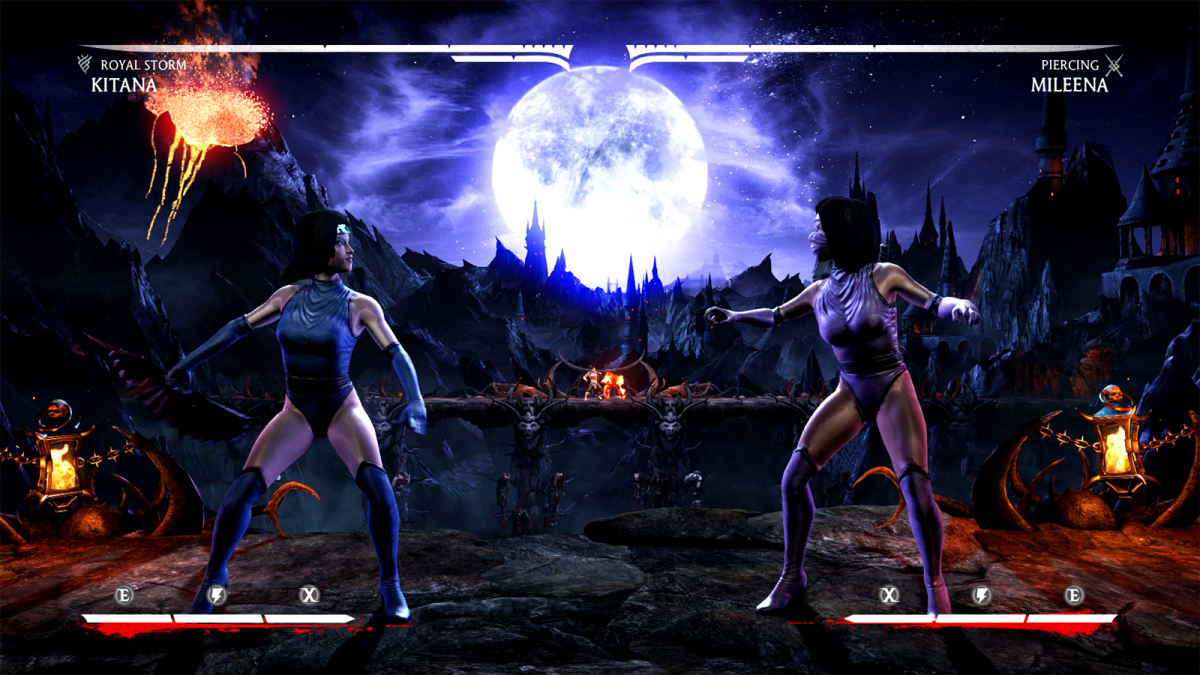
Though the story is a bit of a retread, the same can’t be said of the graphics. MKX looks good, great even in some places. Everything is crisp, though with a dark and gritty coating to it overall. I’m not a big fan of this, especially as compared with the previous game, which had a hazier glow. MKX sometimes is too dark for its own good and it could use some lighting adjustment options, but it’s not a dealbreaker.
Where MKX really shines, however, are the character designs and the stages. The character select screen, in particular, looks fantastic. The character models are nice and incredibly realistic. Every time I boot the game and pick my character, I’m impressed. The game has been out for almost 10 years, and the graphics are still attractive. That’s a good graphics engine. MKX looks better than any of the previous games in the series and that’s a high bar considering MK9 previously set that standard.
MKX also makes good changes in the way it approaches gameplay. Character variations – different builds and movesets attached to characters – are semi-new here since they were originally introduced in Deadly Alliance, but they’re refreshing with some tweaks. The variations actually make sense when you think about them in terms of who the character is, which is a nice plus. I wasn’t a fan of it originally in Deadly Alliance, but it grew on me over the years, and it’s nicely implemented here. Combos and the fighting engine, the name of the game, work well. The game is easy to pick up and play even if you haven’t had previous experience with a 3D fighting game or haven’t played around with the genre in a long time. I took a long break from MK between entries in the Reboot Era and found it easy to jump in a play with my older favorites.
With time also comes a little more appreciation of the aesthetics of Mortal Kombat. MKX continues the tradition of a good soundtrack, with a few standout tracks such as Lin Kuei Temple Round 1, Jinsei Chamber Round 1 and Round 3, and Dead Woods Round 1. The fact that each stage has distinct tracks and remixes for each round is nice and makes the soundtrack worth listening to outside of the game. Also, if you’re a connoisseur of MK Mobile or MK Onslaught, know that you’re going to hear some of these tracks again. That isn’t a problem, though, because this soundtrack has some bangers.
Great environment aside, I do have some issues with MKX. I’m not a fan of guest characters in Mortal Kombat games, and this particular set of characters is egregious. I have said it before, and I will say it again: I want MK characters in MK. I don’t want to see the Predator, Jason Voorhees or Leatherface; I want to see characters that have some established tie to the franchise or new characters that are making a home in the MK universe because they belong there and fit right in.
And while I got my wish for the latter in the form of the Kombat Kids, it was little farfetched how they were integrated into the story. Cassie, Takeda, Jacqui and Kung Jin are OK characters, but I’m not invested in them. Cassie is slightly interesting because she has the right mix of Johnny Cage’s sassiness and Sonya Blade’s do-gooder seriousness, but everyone else in the “squad” is boring. By comparison, Tekken does the generational descendent concept a lot better.
MKX, overall, is a good fighting game and a good sequel in a time when Mortal Kombat was trying to re-establish relevance. The 10th game in the mighty goriest fighting game franchise didn’t falter in subverting expectations and smartly leveraged the shock value of killing fan favorites in the previous game and redoing one of its worst games into something highly playable. Though it has some flaws in the retread of MK4’s story and its loud focus on Cage and Company, its ability to innovate and take risks pays off in a solid sequel. Not quite a flawless victory, but a highly regarded win, nonetheless.
Score: 4 out of 5