A good Mortal Kombat game borne of deception
 Old MK head that I am in my 40s reviewing this, I was in my mid-20s when I was browbeat into trying another entry in the 3D era. I was milquetoast when it came to this person’s suggestions in general and especially so when it came to gaming and fighting games even further. So, it was with hesitance that I dove into Mortal Kombat: Deception. Given that I didn’t love the 3D era at all at the time, I wasn’t prepared for how deceptively good this entry actually is.
MK Deception gets into the action immediately. In the opening sequence, the Deadly Alliance that was established in the previous titular game falls apart. Jealousy and paranoia sink in between Shang Tsung and Quan Chi after they defeat Raiden. But just as Quan Chi attempts to claim the spoils of battle and control of the dread Dragon King’s army, the long-dead and feared ruler known as Onaga pops in with a “I heard y’all was talking about me,” and proceeds to wreck everything. As narrated by the now-infamous Shujinko, a revived Raiden, Shang Tsung and Quan Chi confront Onaga only to perish in the sacrificial blast Raiden used to try to take down Onaga. Leaving barely a scratch on Onaga, the former ruler of Outworld moves on to his main goal: Konquest. How Onaga, who was poisoned long ago by former Emperor Shao Kahn, returns is the point of Konquest mode, which expounds on the story further. The story is simply written but easy enough to follow, and I like that it introduces new characters such as Shujinko and links to the previous game easily.
And while all this talk of the Dragon King’s return is the rage of the game, the graphics should be, too, because they are gorgeous. Deception improves upon the look of Deadly Alliance and manages to produce a beautiful game for the time. By this point, Midway was two games into the 3D era and had the experience and know-how to improve the graphics in the right direction and it shows in the cool character designs and popping backgrounds. Deception looks like the sophomore game of a trilogy where folks have learned a few things about their design system, and it results in a better-looking game and an ever-increasing in quality soundtrack. Presentation-wise overall, it’s a nice experience and one that fits in the MK series easily.

It’s a better-playing game also. Deception feels faster and combos make more sense. It just plays better, though some of the new fatalities like the Hara-Kiri are dumb. I’m not sure what the developer was thinking about when they came up with killing your own character when you lose, but it’s implemented rather poorly and it just looks stupid, to be honest. The first time I saw a Hara-Kiri in action, I rolled my eyes and thought to myself, “Y’all could have used the extra memory to make some of the other more lame finishing moves stand out.”
That thought was not the last time I came to that specific conclusion because some of the ideas in Deception don’t work well, or well enough to warrant emphasis. Let’s start with Puzzle Kombat, which is one of the worst mini-games to come out of what feels like the 3D Mini-Game era. Puzzle Kombat is not good. Folks of a certain age will recognize immediately that the basis of the mini-game is stolen directly from Super Puzzle Fighter II Turbo, Capcom’s obnoxious gem-busting nerve-grating affair. The main problem here is, Puzzle Fighter is trash. Hot take, I know, but I do not enjoy horrible AI stealing wins constantly. So, when Deception is stealing from trash, you know the result down the line will also be trash, and it is fully and truly. The execution of the mode is sound, but the AI in Puzzle Kombat is just as trash as it is in Puzzle Fighter. You have to wonder if Capcom saw all of the aping going on and decided, you know, just let them have it. And no, the chibi-MK characters are not remotely cute at all. Thankfully, Chess Kombat, while wholly unnecessary, is kind of fun. It’s a productive mode and provides something to do, so I won’t knock it.
But my other gripe is with another mode: Konquest Mode is a chore and it’s boring. Yes, I get it: It’s telling the story of Deception and provides a tutorial in the form of Shujinko running around acquiring powers of MKers. That’s all fine and well, but it’s implemented poorly with clunky controls, and I don’t particularly care about the character at all. Because there are so many mimicry characters in the MK ranks, Shujinko tends to get lost in the shuffle. I’m glad he gets some redemption in modern Mortal Kombat with Mortal Kombat One, but here he’s a failure to launch. The general rule is we do not put adventure into Mortal Kombat. It doesn’t work in the 3D era, doesn’t work here in Deception, and doesn’t work in the New Era. It didn’t work in the Arcade era with Mythologies or Special Forces, and it probably doesn’t work in the Reboot era, either.
Though MK Deception falls a little flat in some areas, it’s not a bad entry in the series. It has some strong points like the presentation and the gameplay and even the fun Chess Kombat mode. It’s a good sequel that, like many other games in the franchise, took chances and mostly succeeded in its attempts at value-adding to the series.
This is a good game borne of Deception.
Score: 3.5 out of 5
Mortal Kombat modus operandi
Mortal Kombat has long included other things to do besides fight to the death. The series has been chock full of modes and mini-games in nearly every entry since the first game introduced Test Your Might.
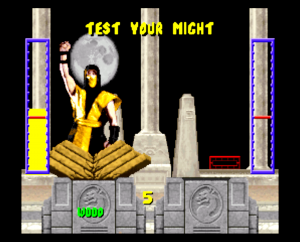
Mode: Test Your Might
Appearances: Mortal Kombat 1992, Mortal Kombat: Deadly Alliance, Mortal Kombat: Shaolin Monks, Mortal Kombat vs. DC Universe, Mortal Kombat 2011, Mortal Kombat Mobile, Mortal Kombat X, Mortal Kombat One
The mini-game that introduced us to Tournament antics. Here, you’re tasked with breaking some type of object, which ranges from stone to diamond. Filling up the meter and appropriately chopping the item awards points in the original game, but awards Koins for the Krypt in Deadly Alliance. It appears three times in the Tournament ladder without extra battles fought in two-player mode.
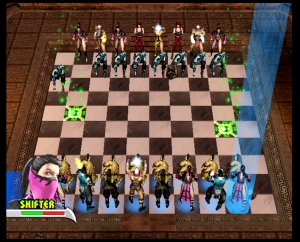
Mode: Chess Kombat
Appearances: Mortal Kombat: Deception
Chess Kombat uses MK characters in Deception to act as chess pieces in a straightforward game of chess. It’s ambitious and if you’re into chess and MK, this is a serious time sink outside of fighting.
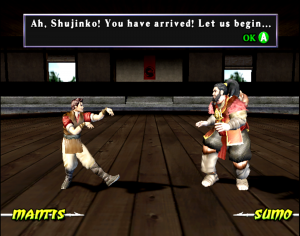
Mode: Konquest Mode
Appearances: Mortal Kombat: Deadly Alliance, Mortal Kombat: Deception, Mortal Kombat: Armageddon
Konquest Mode originally served as a mission mode in Deadly Alliance, with tasks to complete for each character. In Deception, the mode places you in the shoes of Shujinko, an original character sent on a quest to retrieve the Kamidogu. In Armageddon, the mode focuses on new character Taven’s quest to find Blaze.
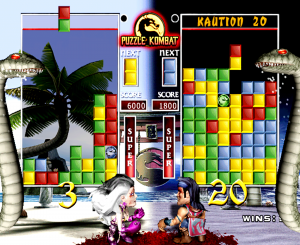
Mode: Puzzle Kombat
Appearances: Mortal Kombat: Deception, Ultimate Mortal Kombat (NDS)
Puzzle Kombat plays a lot like Capcom’s Puzzle Fighter, where you combine gems of the same color into large blocks to break down and defeat your opponent. It’s incredibly cheap and will frustrate with last-minute comebacks from the AI. It’s super cute, but it’s not fun and sometimes gives off the vibe of “is this really necessary in Mortal Kombat?”
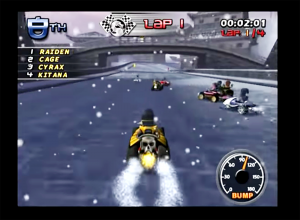
Mode: Motor Kombat
Appearances: Mortal Kombat Armageddon
Mode’s purpose: You select one driver from 10 fighters (Sub-Zero, Jax, Scorpion, Kitana, Mileena, Cyrax, Baraka, Johnny Cage, Bo’ Rai Cho and Raiden) to drive around MK-themed tracks. It’s heavily reminiscent of Super Mario Kart, but it’s just MK enough that you can let it slide.
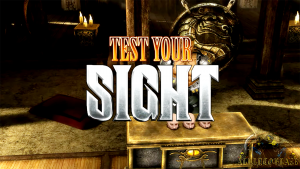
Mode: Test Your Sight
Appearances: Mortal Kombat: Deadly Alliance, Mortal Kombat 2011
Mode’s purpose: Testing your ability to win at a shell game, Test Your Sight has been around for several games. Usually, if you lose at this mini-game, your character meets some grisly fate, which is in tune with Mortal Kombat’s dark humor. Why else would the characters drink poison or use skulls as shell game implements?
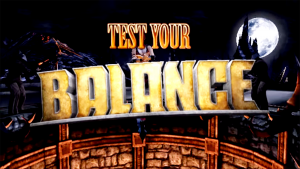
Mode: Test Your Balance
Appearances: Mortal Kombat 2011 (PS Vita only)
Mode’s purpose: The chosen characters test their balance on a beam of death. Failure to maintain balance for a specific period of time means a gruesome death. It’s got fun mechanics that require gyroscope controls with the Vita so it’s innovative and very Mortal Kombat-like.
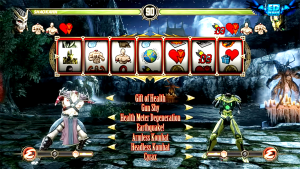
Mode: Test Your Luck
Appearances: Mortal Kombat 2011, Mortal Kombat X, Mortal Kombat Mobile
Mode’s purpose: Test Your Luck, in its original form, is similar to Kombat Kodes found in Mortal Kombat 3. A jackpot slot machine spits out effects that change the rules of kombat. This is a better, modernized way of implementing the clunky Kombat Kode effects and it’s random so it’s always more fun. Most recently, in MK Mobile, it’s the daily login rewards screen.
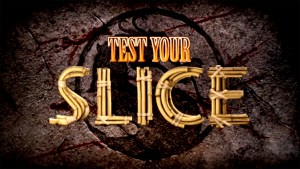
Mode: Test Your Slice
Appearances: Mortal Kombat 2011 (PS Vita only)
Mode’s purpose: Test Your Slice is simple: Slice up random body parts and avoid bombs. Because of the slicing of body parts, we’ll allow it since it fits MK’s dark humor. It allows us to ignore the obvious Fruit Ninja comparisons also.
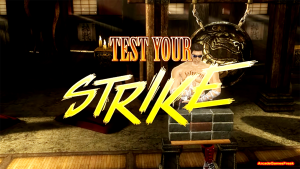
Mode: Test Your Strike
Appearances: Mortal Kombat 2011
Mode’s purpose: This mode is similar to Test Your Might but involves breaking specific objects surrounded in stacks of the same object. The goal is to break the singular object without breaking the others surrounding it, which is infinitely more interesting and challenging than Test Your Might ever was.
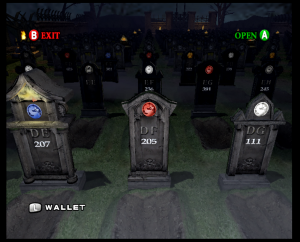
Mode: The Krypt
Appearances: Mortal Kombat: Deadly Alliance, Mortal Kombat: Deception, Mortal Kombat 2011, Mortal Kombat X, Mortal Kombat Mobile, Mortal Kombat 11
Mode’s purpose: The Krypt, in every incarnation, serves as a treasure trove. Making its debut in Mortal Kombat: Deadly Alliance, it serves as the space for unlockable content and goodies related to the lore and history of the Mortal Kombat franchise. You as the wanderer go through unlocking coffins that hold items such as concept art, unlockable characters, alternate skins and stages. In Mortal Kombat Mobile, it serves as a treasure-hunting mode, where health and battle items for use in other modes can be found. It’s a nice way to organize unlockable content and provide a distraction. And with all of its ever-present jump scares and death traps in nearly every iteration, it certainly fits the MK theme.